Marsh Harrier

Western Marsh Harrier – Circus aeruginosus

Classification

  • Kingdom: Animalia
  • Class: Aves
  • Order: Accipitriformes
  • Family: Accipitridae
  • Genre: Circus
  • Species: Circus aeruginosus

Identification characters

The length is 43-55 cm, being the largest erect, slightly larger than the common eared eel. The male has reddish-brown plumage, but the wings and tail are greyish. The female is brownish.

Distribuție

The Western Marsh Harrier has a large nesting range stretching from Europe to Central Asia. It is a migratory species throughout much of its range. It winters in southern Europe, Africa, the Arabian Peninsula and the Indian subcontinent. There are 99,300-184,000 breeding females in Europe, with an increasing population trend. The largest flocks are in Russia, Ukraine, Poland and Belarus. In Romania, the reed warbler is a widespread breeding species, very common in the Danube Delta and rarer in Transylvania. It is absent in mountainous areas. It is mainly found during the passage and nesting season. In the cold season it can be seen wintering only in Dobrogea and the southernmost parts of Romania. The population in Romania is estimated at 9,334-22,314 nesting females.

Living environment and biology of the species

Western Marsh Harrier prefer wet areas with extensive reed beds for nesting. Rarely, it nests in intensive agricultural crops such as cereal crops. Foraging territory includes wetlands and farmland. It feeds mainly on small to medium-sized aquatic or terrestrial vertebrates such as rodents, baby rabbits, ducks, lizards, etc. It also eats eggs, frogs, larger insects and even fish. It flies between 2 and 6 m above the ground, and when it identifies prey, it dives suddenly.

The pair formed can last for several seasons. The mating ritual is spectacular. The male flies in circles over the nesting territory, then dives to the ground, rolling in the air. Sometimes the female accompanies him in flight and they roll together in the air, claws together. The male can be seen offering food in the air to the female. Polygamy can occur, in which case the male may mate with 2-3 females. Can live up to 20 years.

The nesting period is from the second half of April to mid-June. The nest is built by the female in dense and extensive reed beds of branches and reeds, lined inside with grass, and can be up to 80 cm in diameter. The clutch consists of 3-8 eggs, laid in the second half of April. The eggs are incubated by both parents for 31-38 days. The chicks are nestlings. They leave the nest 35-40 days after hatching. The chicks are cared for by the female only. It is the male that hunts and feeds his family during the nesting period. After leaving the nest and being able to fly, the juveniles remain close to their parents for another 25-30 days and only then become independent.

Threats and conservation measures

Western Marsh Harrier are threatened by pollution, poor water management and poaching. Conservation measures are recommended: respect of restrictions in riparian areas, waste management in wetlands, conservation of reedbeds and reedbeds with permanent water, prohibition of harvesting or burning reeds, measures to avoid drying and sudden artificial change of water regime in wetlands. Only selective and low-toxicity agrochemicals should be used on agricultural land in the vicinity of wetlands. Hunting legislation should be respected, with the cooperation of environmental protection organisations, hunting organisations, the gendarmerie and the Environmental Guard. Inventory of current and potential breeding areas, migration, feeding and aggregation areas important for the conservation of the species and in particular promotion of studies on the biology of the species and study of demographic parameters are needed.

Bibliography

  • Fântână Ciprian, Kovács Istvan, Benkő Zoltán, Daròczi Szilárd, Domșa Cristian, Veres-Szászka Judit (editors), 2022, Atlas of bird species of community interest in Romania, 2nd edition – Love birds, save nature!, Project financed by the European Regional Development Fund through the Large Infrastructure Operational Programme 2014-2020, Ministry of Environment, Water and Forests – Biodiversity Directorate, scientific coordination Romanian Ornithological Society and Association for the Protection of Birds and Nature Milvus Group, produced by EXCLUS PROD SRL, p. 144.
    Svensson (text and maps), 2017, Guide to bird identification. Europe and the Mediterranean area, translation and adaptation into Romanian: Romanian Ornithological Society, Emanuel Ștefan Baltag, Sebastian Bugariu, Alida Barbu, p. 102.
    Radu Dimitrie, 1983, Small Ornithological Atlas – Birds of the World, Albatros Publishing, Bucharest, p. 135.

Pochard

Common Pochard – Aythya ferina

Classification

  • Kingdom: Animalia
  • Class: Aves
  • Order: Anseriformes
  • Family: Anatidae
  • Genre: Aythya
  • Species: Aythya ferina

Identification characters

It is a medium-sized diving duck. The duck has a conical appearance, a long neck and beak. The wings have grey, blurred stripes. The nesting male has a deep brown head, black bill, reddish eyes, glossy black breast, light grey flanks and back, black hindquarters. In the eclipse the breast and hindquarters dark grey-brown and the head faded reddish. Female has grey-brown body and reddish-brown eyes Show orbital ring and a line behind the eye. Juveniles resemble the adult female, have olive-yellow eyes, lacking the line behind the eye.

Distribution

The species has a large breeding range, covering central and southern Europe, western and central Asia and wintering in southern Europe, Asia Minor, northern Africa and southern Asia. The European population is 397,000-570,000 individuals.

In Romania it is a relatively common breeding species in areas with suitable habitat, being found in Dobrogea, Muntenia, Oltenia, Banat, Moldova and Transylvania. In winter, important flocks are confined to the Delta, the Danube and the rivers and lakes bordering the country’s large rivers. In Romania there are 3,050-12,315 breeding pairs, with a decreasing trend. Between 20,000 and 40,000 individuals can be observed during the passage. A total of 14,549 to 35,738 winter here.

Living environment and biology of the species

The species can be found in a wide variety of wetlands. It prefers fresh or brackish lakes of at least several hectares in size, 1.5-2m deep, with rich submergent vegetation and surrounded by dense reed beds. In winter and during migration, it can also be found on reservoirs.

It is an omnivorous species, consuming mainly submerged vegetation but also aquatic insects and small crustaceans. Food is obtained mainly by diving. Strongly gregarious outside the nesting season. Males begin to associate in small flocks from the second half of May, when females are still on the nest. and nest near water on the ground in dense vegetation.

May also nest on the wetland, nesting above water level on the solid substrate formed by the lying reed stalks. The nesting period lasts from mid-April to early May and mid-June. Only one clutch is laid each year, consisting of 8-10 elliptical greenish-grey eggs, which the female incubates alone for 25 days. The chicks are nidifugous, leave the nest a few hours after hatching and are cared for only by the female.

Threats and conservation measures

The species is threatened by habitat loss and alteration, pollution and poor water management, hunting, mortality from fishing gear, anthropogenic disturbance. It is recommended to respect restrictions in riparian and coastal areas, maintain wetland vegetation at an ecologically optimal level, manage waste and wastewater in the area of important habitats for the species, use selective and low toxicity agrochemicals, avoid the use of treated seeds in the vicinity of wetlands, manage water levels in reservoirs according to the needs of the species, creating islands to reduce the risk of predation and to help the species breed in artificial or semi-natural wetlands, banning hunting and poaching, limiting the use of fishing nets to prevent birds from being accidentally caught, inventorying breeding areas, identifying important migration, feeding and crowding areas for the species, promoting studies on the biology of the species.

Bibliography

  • Fântână Ciprian, Kovács Istvan, Benkő Zoltán, Daròczi Szilárd, Domșa Cristian, Veres-Szászka Judit (editors), 2022, Atlas of bird species of community interest in Romania, 2nd edition – Love birds, save nature!, Project financed by the European Regional Development Fund through the Large Infrastructure Operational Programme 2014-2020, Ministry of Environment, Water and Forests – Biodiversity Directorate, scientific coordination Romanian Ornithological Society and Association for the Protection of Birds and Nature Milvus Group, produced by EXCLUS PROD SRL, p. 144.
    Svensson (text and maps), 2017, Guide to bird identification. Europe and the Mediterranean area, translation and adaptation in Romanian: Romanian Ornithological Society, Emanuel Ștefan Baltag, Sebastian Bugariu, Alida Barbu.
    Radu Dimitrie, 1983, Small Ornithological Atlas – Birds of the World, Albatros Publishing, Bucharest, p. 135.

Whiskered Tern

Whiskered Tern- Chlidonias hybrida

Classification

  • Kingdom: Animalia
  • Class: Aves
  • Order: Charadriiformes
  • Family: Laridae
  • Genre: Chlidonias
  • Species: Chlidonias hybrida

Identification characters

Body length about 25 cm, grey plumage, blackish crown, white cheek.

Distribution

The Whiskered Tern is found in the southern and eastern parts of the European continent and winters in Africa and the Arabian Peninsula. The European population is relatively small and is between 66,300 and 108,000 breeding pairs. In Romania, the breeding population is between 10,000 and 20,000 pairs, and between 30,000 and 100,000 birds can be observed during passage.

Living environment and biology of the species

It is characteristic of freshwater wetlands, rich in vegetation. Feeds on small fish, adult insects and their larvae, crustaceans, snails and small frogs. It catches prey by sudden slides from about 5 m high. Glides on the spot, flapping its wings in pursuit of prey. Feeds up to 1-2 km from the breeding colony. Average life span is nine years, but can be up to 19 years. Reaches sexual maturity at the age of two. Arrives from wintering quarters in the second part of April and early May. It is a monogamous and territorial species. Forms monospecific colonies of up to 100 pairs, in which nests are located 1-5 m apart. The species’ preferred nesting habitats are marshes with isolated water meshes and vegetation grazed by cattle and horses.

The nest consists of plant debris and is laid on floating vegetation in areas where the water is shallow, less than 1 m. The female typically lays 2-3 eggs in the second part of May and the second part of June, with an average size of 37.7 and 28.6 mm. Incubation lasts around 18-20 days and is carried out by both partners. The chicks leave the nest a few days after hatching and are cared for by the adults. They become fledglings 21-25 days after hatching. In the first winter they have an intermediate plumage between juvenile and adult.

Threats and conservation measures

The species is threatened by habitat loss and alteration, pollution and poor water management. It is recommended to respect restrictions in riparian and coastal areas, maintain wetland vegetation at an ecologically optimal level, manage waste and sewage in habitats important to the species, maintain a minimum of 1.5 uncultivated strips between cultivated land and wetlands where the use of chemicals is prohibited. The use of selective and low-toxicity agrochemicals is encouraged and the use of treated seeds in the vicinity of wetlands should be avoided. Organic production is encouraged.

Management of water levels in reservoirs in accordance with the ecological needs of the species and the creation of artificial islands to increase breeding success in wetlands is recommended. An inventory of breeding, migration, feeding and aggregation areas important for the conservation of the species is needed. It is also useful to promote studies on the biology of the species.

Bibliography

  • Fântână Ciprian, Kovács Istvan, Benkő Zoltán, Daròczi Szilárd, Domșa Cristian, Veres-Szászka Judit (editors), 2022, Atlas of bird species of community interest in Romania, 2nd edition – Love birds, save nature!, Project financed by the European Regional Development Fund through the Large Infrastructure Operational Programme 2014-2020, Ministry of Environment, Water and Forests – Biodiversity Directorate, scientific coordination Romanian Ornithological Society and Association for the Protection of Birds and Nature Milvus Group, produced by EXCLUS PROD SRL, p. 280.
    Radu Dimitrie, 1983, Small Ornithological Atlas – Birds of the World, Albatros Publishing, Bucharest, p. 86.

Ferruginous Duck

Ferruginous Duck – Aythya nyroca

Classification

  • Kingdom: Animalia
  • Class: Aves
  • Order: Anseriformmes
  • Family: Anatidae
  • Genre: Aythya
  • Species: Aythya nyroca

Caractere de identificare

It is a medium to small diving duck. High forehead, pointed beak. Long beak and neck. In the adult the underparts and the anterior part of the abdomen are white. The nesting male has deep brown plumage with a purple tinge, except for the undertail and white patch on the abdomen, and white eyes. The female has dark brown plumage with a reddish tinge on the crown and white underparts. The male in eclipse looks more like the female, but differs from her by its white eyes and reddish plumage. Juveniles resemble the adult female, with a dull brown body and duller white underparts and belly patch.

Distribution

It nests in central and southern Europe and southwest Asia. In the cold season it can be found in southern Europe, Asia Minor, northwest and west Africa, the Near East and Southeast Asia. In Romania, it is a breeding species in Dobrogea (with large populations in the Danube Delta, Muntenia, Oltenia, Moldova, Banat and less frequently in Transylvania. Larger numbers are recorded in the passage. In recent years, flocks in the order of tens of individuals are regularly observed in winter. The population in the country is 2,628-10,464 breeding pairs. The wintering population is 24-74 individuals. Between 10,000 and 30,000 individuals may be observed during passage.

Living environment and biology of the species

In the nesting season it is found in the area of lowland lakes with abundant submerged vegetation, bordered by dense swathes of emergent marsh vegetation consisting of reeds, sedges and willows. It can also nest in fishponds or brackish water. Outside the nesting season it can be found on a wider range of wetlands. It prefers shallow water between 30-100 cm. Lives hidden on open water in dense reed beds.

Food is plant food, mainly seeds and vegetative parts of aquatic plants, but it can also eat molluscs, crustaceans, insects or even small fish. It obtains food either by diving or from the surface of the water, swimming with its beak or head at water level. It is a migratory species. It is less gregarious, rarer and more reclusive than the brown-headed duck. Pairs form in wintering quarters. It roosts very close to the water, on banks or on islets in dense marsh vegetation.

The nest is built mainly of reed fragments. The nesting period is from mid-April to mid-June. The clutch consists of 8-10 eggs and is incubated for 25 to 27 days. The chicks are nidifid.

Threats and conservation measures needed

The species is threatened by habitat loss and alteration, pollution and poor water management, poaching, mortality from fishing gear, anthropogenic disturbance.

It is recommended to respect restrictions in riparian and coastal areas, maintain wetland vegetation at an ecologically optimal level, manage waste and wastewater in areas of important habitat for the species, use selective and low toxicity agrochemicals, avoid the use of treated seeds in the vicinity of wetlands, encourage organic production, manage water levels in reservoirs in accordance with the ecological needs of the species, creation of islands to reduce the high risk of predation and increase breeding success in artificial or semi-natural wetlands, compliance with hunting legislation, control of poaching, reduction in the use of fishing nets to prevent accidental capture of birds, inventory of current and potential breeding areas, identification of migration, feeding and aggregation areas important for the conservation of the species, promotion of studies on the biology of the species.

Bibliography

  • Fântână Ciprian, Kovács Istvan, Benkő Zoltán, Daròczi Szilárd, Domșa Cristian, Veres-Szászka Judit (editors), 2022, Atlas of bird species of community interest in Romania, 2nd edition – Love birds, save nature!, Project financed by the European Regional Development Fund through the Large Infrastructure Operational Programme 2014-2020, Ministry of Environment, Water and Forests – Biodiversity Directorate, scientific coordination Romanian Ornithological Society and Association for the Protection of Birds and Nature Milvus Group, produced by EXCLUS PROD SRL, p. 144.
    Svensson (text and maps), 2017, Guide to bird identification. Europe and the Mediterranean area, translation and adaptation into Romanian: Romanian Ornithological Society, Emanuel Ștefan Baltag, Sebastian Bugariu, Alida Barbu, p. 102.
    Radu Dimitrie, 1983, Small Ornithological Atlas – Birds of the World, Albatros Publishing, Bucharest, p. 135.

Robin

European Robin- Erithacus rubecula

Classification

  • Kingdom: Animalia
  • Class: Aves
  • Order: Passeriformes
  • Family: Muscicapidae
  • Genre: Erithacus
  • Species: Erithacus rubecula

Identification characters

Body length is 14 cm. Also known as the red-necked goose, the robin is distinguished by the rusty patch on the chin and breast, while the rest of the body is brownish in both sexes.

Distribution

It is a wide-ranging species, stretching from Europe to Siberia, North Africa and Turkey. Birds from the north and east of the continent migrate southwest in winter. The wintering range extends from Great Britain to Spain and Morocco, as well as south-eastern Europe. The breeding population in Europe is between 58,700,000 and 90,500,000 pairs, representing 90% of the global population, and is increasing. In Romania, the common merganser is common throughout the country, from lowland to mountainous areas. The breeding population of the species in Romania is between 2,586,175 and 3,164,275 pairs.

Living environment and biology of the species

The European Robin prefers areas with alternating open and open moorland. In northern Europe it prefers spruce and mixed woodlands. The Puffin is a secretive but not skittish bird. It reaches sexual maturity at the age of one year. It feeds on various invertebrates, seeds and various fleshy fruits. A diurnal species, but also becomes active if there are artificial light sources, or if the moonlight is very bright. Migrating birds return in February to breed.

Nests in shady habitats, found in woodlands, bushes and parks. It is a common bird in gardens, parks and dense or undergrowth forests. It is a territorial and monogamous species. During the nuptial ritual, the male feeds the female. They nest in overhangs, tree roots, cracks in walls. The nest can also be suspended, usually up to 1.40 m above the ground. The nest is built by the female from various plant debris and is lined with animal hair and thin roots.

She usually lays two, rarely three eggs per year, which consist of 5-7 eggs. Brooding is carried out solely by the female for 13-14 days. The young leave the nest 12-15 days after hatching. Both parents participate in the rearing of the chicks.

Threats and conservation measures

Habitat change, fragmentation and loss, as well as pollution, are factors that can threaten the populations of the roseate tern. Conservation requires matching silvicultural work to the biology of the species to avoid disturbance during critical periods, maintaining understory in logged forests, maintaining a mosaic of habitats with tree and shrub patches in open agricultural areas, maintaining corridors between areas of spontaneous grassland including scattered trees, tree lines and groups of non-productive trees, avoiding afforestation of reedbeds, preserving woodlands with the aim of restoring degraded habitats, preventing or penalising illegal bush fires. An inventory of breeding, migration, feeding and aggregation areas important for the conservation of the species is needed. It is also useful to promote studies on the biology of the species.

Bibliography

  • Fântână Ciprian, Kovács Istvan, Benkő Zoltán, Daròczi Szilárd, Domșa Cristian, Veres-Szászka Judit (editors), 2022, Atlas of bird species of community interest in Romania, 2nd edition – Love birds, save nature!, Project financed by the European Regional Development Fund through the Large Infrastructure Operational Programme 2014-2020, Ministry of Environment, Water and Forests – Biodiversity Directorate, scientific coordination Romanian Ornithological Society and Association for the Protection of Birds and Nature Milvus Group, produced by EXCLUS PROD SRL, p. 396.
    Radu Dimitrie, 1983, Small Ornithological Atlas – Birds of the World, Albatros Publishing, Bucharest, p. 199.

Kestrel

Common Kestrel – Falco tinnunculus

Classification

  • Kingdom: Animalia
  • Class: Aves
  • Order: Falconiformes
  • Family: Falconidae
  • Genre: Falco
  • Species: Falco tinnunculus

Identification characters

The body is rusty, about 35 cm long, with blackish spots on the back and chest. Males have a bluish head and tail and a blackish moustache at the corner of the mouth.

Distribution

The Common Kestrel has a very wide range, occurring in almost all of Europe, Asia and Africa, from the UK to China and as far south as southern Africa. The vast majority of the European population is sedentary, but northern and western populations are migratory, wintering in southern Europe and sub-Saharan Africa. The European population represents 19% of the world population, with 409,000-603,000 breeding pairs. In Europe, a decline of up to 25% over three generations is estimated. In Romania, the redstart is widespread throughout the country and populations can be sedentary or partly migratory, depending on the conditions of the year. Romania’s population of red-winged teal is estimated at 20,000-50,000 breeding pairs.

Living environment and biology of the species

The Common Kestrel occupies almost all habitats from sea level to 3,000-3,500 m altitude (in the Caucasus), including parks, orchards, small patches of forest, agricultural and suburban areas, rocky areas, settlements, river valleys. In Romania, together with the common titmouse, it is the most common diurnal raptor, nesting in almost all types of habitats, except in closed forests and regions totally devoid of trees. The vast majority of birds in Romania move south in winter. Few individuals, predominantly males, remain to winter in the country.

It feeds mainly on insects, but also on a wide variety of small rodents, birds and reptiles, which it captures by following them from a height, flying from a fixed vantage point or from the air. It is able to see ultraviolet radiation reflected from urine droplets that mark the trails of mice, which it hunts with great efficiency. It is a monogamous species.

It mostly nests singly, but under favourable and colonial conditions. Cases of bigamy have also been recorded, probably as a consequence of colonial nesting. The nest is installed in tree ledges, crevices or holes in walls, cornices, in old crow, raven, magpie nests. The nest is usually built from branches and other hard plant parts and can be used for several years at a time. The nesting period is from April-May to August in the northern hemisphere. The clutch usually consists of 4-5 eggs, sometimes 6, which are laid mainly by the female, but also by the male. Incubation time is 21-25 days. The chicks leave the nest after 28-32 days, but stay with the parents for another 30 days, sometimes even into the autumn months.

Threats and conservation measures

Threats include: habitat loss and alteration. disturbance caused by forestry. alteration of trophic resources, pollution and illegal use of poisons, poaching in the vicinity of nesting sites. Conservation measures include prohibition of any activity that causes disturbance to the species’ breeding, feeding and resting habitats, including new urban development in habitats important to the species. No new wind farms should be built near breeding and feeding areas. It is important to avoid strong herbicides, which reduce the diversity of food species, leading to bioaccumulation of these treatments, which secondarily cause bird poisoning.

A mosaic landscape should be maintained and developed, and corridors maintained between areas of wild grassland including trees, tree lines and clumps of trees. Grassland should be maintained and no burning should be allowed. Bird safety is also ensured through the management of telecommunication cables. An inventory of breeding, migration, feeding and agglomeration areas important for the conservation of the species is required.

It is also useful to promote studies on the biology of the species, to obtain information on the use of poisons and their effects on the species. The use of poisoned bait should be banned, as should the illegal devastation of nests. Against poaching, cooperation between environmental organisations, hunting organisations, the gendarmerie and the Environmental Guard is essential. It is also recommended that artificial nests be installed in habitats suitable for the species.

Bibliography

  • Fântână Ciprian, Kovács Istvan, Benkő Zoltán, Daròczi Szilárd, Domșa Cristian, Veres-Szászka Judit (editors), 2022, Atlas of bird species of community interest in Romania, 2nd edition – Love birds, save nature!, Project financed by the European Regional Development Fund through the Large Infrastructure Operational Programme 2014-2020, Ministry of Environment, Water and Forests – Biodiversity Directorate, scientific coordination Romanian Ornithological Society and Association for the Protection of Birds and Nature Milvus Group, produced by EXCLUS PROD SRL, p. 172.
    Radu Dimitrie, 1983, Small Ornithological Atlas – Birds of the World, Albatros Publishing House, Bucharest, p. 139.

Little Bittern

Little Bittern – Ixobrychus minutus

Classification

  • Kingdom: Animalia
  • Class: Aves
  • Order: Pelecaniformes
  • Family: Ardeidae
  • Genre: Ixobrychus
  • Species: Ixobrychus minutus

Identification characters

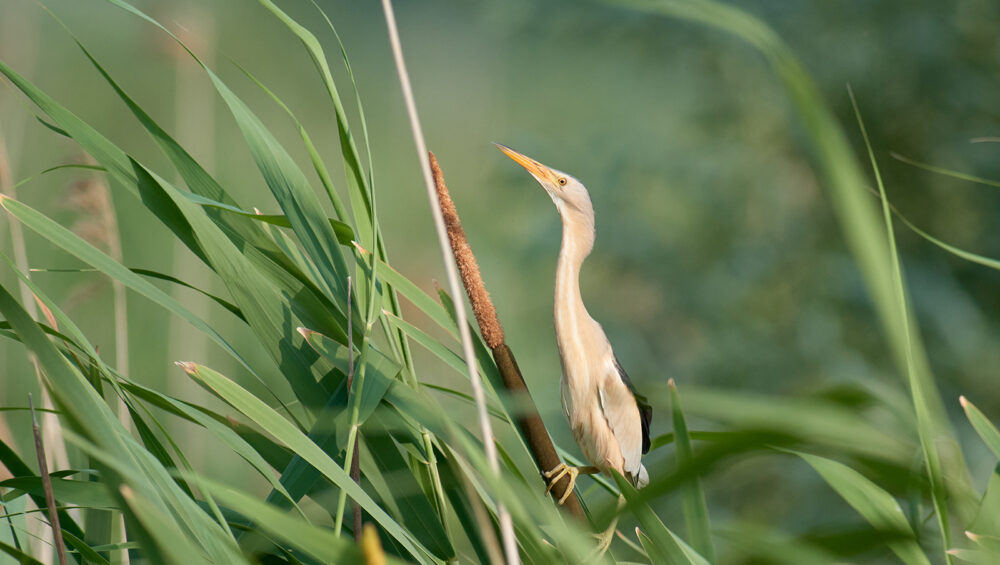
It is the smallest Bittern, smaller than a moorhen, the adult being 33-38 cm long. Males are yellowish in colour with a blackish mid-back and wings. Females and
young have reddish-brown plumage.

Distribution

The species has a Palaearctic range, with a large range distribution. It is a migratory species, wintering mainly in central and southern Africa. The European population of the species is relatively small, ranging from 63,000 to 11,000 pairs. In Romania, the Dwarf Tern is found in the Danube Delta, but also in those inland wetlands that meet the habitat conditions. In Romania the breeding population is between 27,079 and 49,335 pairs.

Living environment and biology of the species

The Little Bittern can be seen in wetland habitats with reeds and water lustre in areas with dense aquatic vegetation. It can also be found on lake margins, ponds, stream margins where woody vegetation predominates. A summer bird in our country, it is quite hard to spot, being hidden in reeds. It lives alone or in pairs, sometimes in small groups during migration. It feeds on fish, amphibians and various invertebrates such as insects, spiders, molluscs and crustaceans. Sometimes it even catches reptiles and small birds. Predominantly active at dusk. The species is monogamous.

The nest can be located solitarily or in small colonies at least 5 m apart. Arrives at nest sites in early April. The male chooses a nest site with straw, reeds and leaves in the reed thicket to protect the young from predators. The nest is made of reeds, reeds and other plant debris and is shaped like a shallow dish. Both parents participate in nest building.

The female lays 5-7 whitish eggs with bluish-green tints in the second half of May. If conditions are favourable, the female also lays a second clutch in June. Incubation is provided by both parents. After 16-19 days the chicks hatch. They remain in the nest for 7-9 days, during which time the parents feed them with insect larvae, insects, tadpoles, and sometimes even a leech. After leaving the nest, the chicks stay around the nest and still ask for food from the parents. A month after hatching, they begin to fly, becoming able to feed themselves.

Threats and conservation measurese

The species is threatened by habitat loss and alteration, pollution and poor water management, poaching. As such, conservation measures are required, such as: observance of restrictions in riparian areas, waste management in wetlands, conservation of reedbeds and reedbeds as characteristic habitat, prohibition of reed burning, protection of nesting and feeding sites, conservation of forests in the vicinity of aquatic habitats, encouragement of measures to avoid drying up and sudden artificial change of water regime in wetlands.

Encourage the use of selective and low-toxicity agrochemicals on nearby land. In order to avoid poaching, it is recommended to control and respect hunting legislation, cooperation between environmental protection organisations, hunting organisations, the gendarmerie and the Environmental Guard. It is important to inventory current and potential breeding areas, migration, feeding and aggregation areas important for the conservation of the species. Studies on various aspects of the biology of the species, including demographic parameters, are of great importance.

Bibliography

  • Fântână Ciprian, Kovács Istvan, Benkő Zoltán, Daròczi Szilárd, Domșa Cristian, Veres-Szászka Judit (editors), 2022, Atlas of bird species of community interest in Romania, 2nd edition – Love birds, save nature!, Project financed by the European Regional Development Fund through the Large Infrastructure Operational Programme 2014-2020, Ministry of Environment, Water and Forests – Biodiversity Directorate, scientific coordination Romanian Ornithological Society and Association for the Protection of Birds and Nature Milvus Group, produced by EXCLUS PROD SRL, p. 114.
    Svensson (text and maps), 2017, Guide to bird identification. Europe and the Mediterranean area, translation and adaptation into Romanian: Romanian Ornithological Society, Emanuel Ștefan Baltag, Sebastian Bugariu, Alida Barbu, p. 80.
    Radu Dimitrie (1983)- Mic atlas ornitologic – Pajările lumii, Editura Albatros, București, p. 67.

Nightingale

Common Nightingale – Luscinia megarynchos

Classification

  • Kingdom: Animalia
  • Class: Aves
  • Order: Passeriformes
  • Family: Muscicapidae
  • Gen: Luscinia
  • Species: Luscinia megarynchos

Identification characters

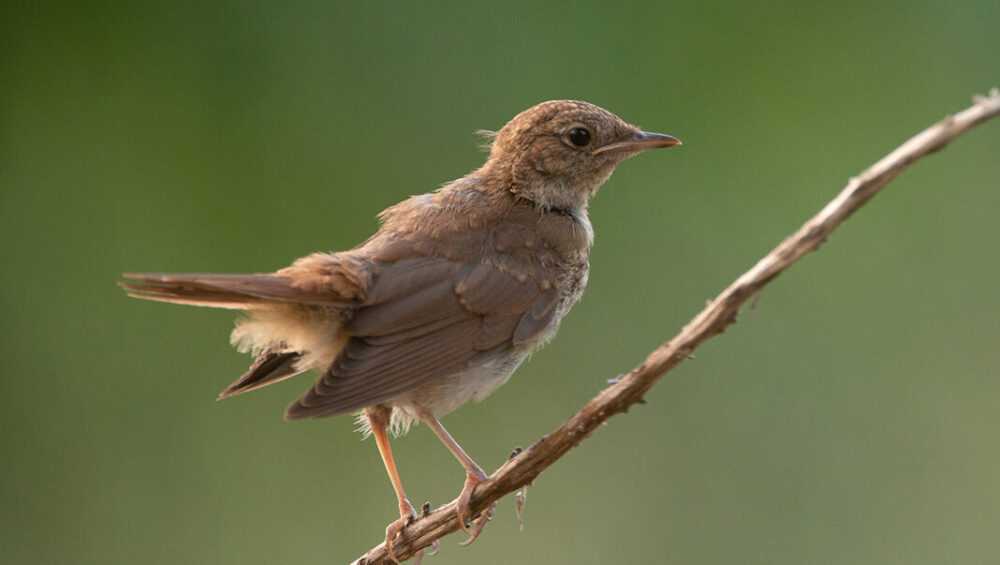
The body is 16 cm long, brownish and the tail is rusty. It has a very pleasant song.

Distribution

It is a widespread species in the western Palaearctic. It is found in Europe and northern Africa, southern Russia, as far east as Crimea and the Krasnodar peninsula, Turkey and the Levant, Iran, Turkmenistan and Mongolia. It is a migratory species, with most European populations wintering in eastern central Africa. The European population is between 10,700,000 and 20,300,000 breeding pairs, representing half of the world population of the species. In Romania, the Nightingale is more common in the hilly area of Moldavia, the Transylvanian Depression and in the plains along the lower reaches of the Danube. The breeding population in Romania is estimated at 714,687-1,010,434 pairs and is important at European level.

Living environment and biology of the species

It lives in forests with rich undergrowth, in parks, meadows and scrublands, often near wetlands, but also in drier areas with dense scrub. Very commonly it can be found in man-made habitats such as orchards, gardens and parks in towns. Maximum longevity is eight years and four months. Sexual maturity is reached at the age of one year.

Food consists of adult and larval insects, spiders, snails, other small invertebrates. Fruit and sometimes seeds. Feeds both on the ground and in the foliage. It is a monogamous species, with the nesting season starting in mid-May. The nuptial song is performed mainly by the male, throughout the day, evening and sometimes all night. The song is distinctive, very beautiful and with many intonations, varying depending on finding a female and establishing a pair. The mating season is extremely exhausting for the males, who expend a great deal of energy singing and chasing other suitors out of their own territory.

The nest is set up on the ground or in low vegetation in the undergrowth, no more than 30 cm above the ground, very well camouflaged. It is constructed by the female from various plant materials, such as dry leaves and blades of grass. The eggs consist of 4-6 eggs, hatched by the female for 13-14 days. The eggs are dark blue or blue-green in colour, very finely mottled with reddish-brown. The chicks remain in the nest for 11-12 days until they reach flight age, during which time they are fed by both parents.

Threats and conservation measures

The species may be threatened by habitat alteration, fragmentation and loss, habitat alteration and loss due to agricultural activities or land use change, contamination by agricultural products. Many and varied conservation measures are recommended, such as matching silvicultural work to the biology of the species to avoid disturbance during breeding seasons, maintaining understory in logged forests, maintaining a mosaic of habitats with tree and shrub stands in open agricultural areas, maintaining and enhancing corridors between areas of spontaneous grassland including scattered trees, tree lines and groups of non-productive trees, reducing the use of insecticides and herbicides in agriculture and forestry. Where necessary and in the absence of alternatives, the use of substances with minimal toxicity and persistence should be justified and applied on the breeding grounds of the species only outside the breeding season. Afforestation of bushland areas should be avoided and bush fires should be avoided and penalised. It is recommended to inventory both actual and potential breeding areas.

Bibliography

  • Fântână Ciprian, Kovács Istvan, Benkő Zoltán, Daròczi Szilárd, Domșa Cristian, Veres-Szászka Judit (editors), 2022, Atlas of bird species of community interest in Romania, 2nd edition – Love birds, save nature!, Project financed by the European Regional Development Fund through the Large Infrastructure Operational Programme 2014-2020, Ministry of Environment, Water and Forests – Biodiversity Directorate, scientific coordination Romanian Ornithological Society and Association for the Protection of Birds and Nature Milvus Group, produced by EXCLUS PROD SRL, p. 402.
    Radu Dimitrie, 1983, Small Ornithological Atlas – Birds of the World, Albatros Publishing House, Bucharest, p. 198.

Black-headed Gull

Black-headed Gull – Larus ridibundus

Classification

  • Kingdom: Animalia
  • Class: Aves
  • Order: Charadriiformes
  • Family: Laridae
  • Genre: Larus
  • Species: Larus ridibundus

Identification characters

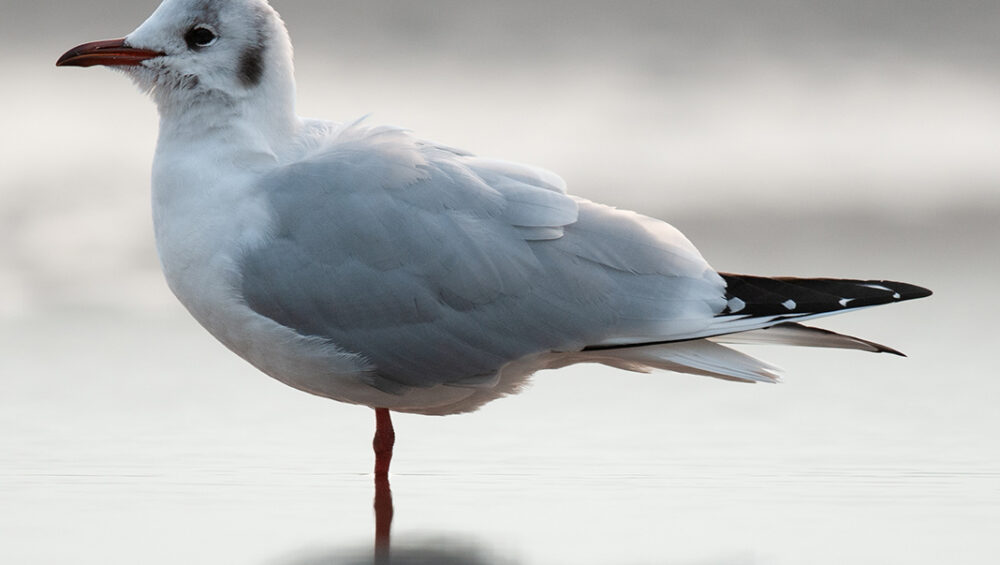
Average body length 38 cm, silvery on the back, with dark tan head and wing tips, and white on the rest of the body. In winter, the head is completely white, with a black spot in the ear region.

Distribution

The breeding population in Europe is very large, ranging from 1,340,000 to 1,990,000 pairs. In Romania, the breeding population is between 4,000 and 10,000 pairs and is on an increasing trend, with passage flocks of 100,000-300,000 birds.

Living environment and biology of the species

The species nests mainly inland. Prefers shallow, temporarily flooded wetlands with tall vegetation. Colonies form on the shores of lakes, lagoons, slow-flowing rivers, in deltas, mounded marshes, but may nest in raised areas of salt marshes, on dunes and islands near coasts. It also uses artificial habitats such as puddles, drains, swamps, canals and flooded areas. It can also nest in drained marshes, sand dunes, coastal areas and rocky islands. In winter it occurs mainly in coastal habitats, with a preference for estuaries with sandy or muddy shores, and generally avoids rocky or exposed coastal areas. During this period it may occur inland visiting arable land, wet grassland, parks, sewage works, water reservoirs and roosts on sandy and gravelly lake shores. In the wild, the average lifespan is 11 years.

Sexual maturity is reached at the age of two. Feeds in various habitats, mainly on animal food. It watches tractors sowing, visits landfill sites and dumping sites for household waste along rivers. It catches live animals, but doesn’t turn down carrion either. It hunts in April and May in high-density colonies of several thousand pairs, often with other gull and chub species. In these colonies each pair defends its territory. In the mating ritual, the male feeds the female. The behaviour of individuals in the colony is influenced by complex rituals, accompanied by loud calls.

It builds a very simple nest on the ground or between plants. The clutch of 2-3 eggs is hatched by both parents for 23-26 days. The chicks do not leave the nest immediately, but by the age of 10 days they are already moving away from it. Both parents are involved in feeding and defending the young. They leave the nest for good after 33-37 days, when they can fly. A laughing gull’s prey produces only one brood per year.

Threats and conservation measures

The species is threatened by habitat loss and alteration, pollution and poor water management. It is recommended to respect restrictions in riparian and coastal areas, including those related to construction, management of water levels in aquatic ecosystems in accordance with the ecological needs of the species, management of waste and wastewater around wetlands, assessment of pollution levels in the wetland and implementation of programmes to improve water quality.

Anthropogenic activities near colonies can be limited by creating a buffer zone of at least 50 m, where fish farmers should be prohibited from nesting. It is important to encourage the use of selective and low toxicity agrochemicals and to avoid the use of treated seeds on neighbouring land. It is necessary to inventory breeding, migration, feeding and aggregation areas important for the conservation of the species. It is also useful to promote studies on the biology of the species.

Bibliography

  • Fântână Ciprian, Kovács Istvan, Benkő Zoltán, Daròczi Szilárd, Domșa Cristian, Veres-Szászka Judit (editors), 2022, Atlas of bird species of community interest in Romania, 2nd edition – Love birds, save nature!, Project financed by the European Regional Development Fund through the Large Infrastructure Operational Programme 2014-2020, Ministry of Environment, Water and Forests – Biodiversity Directorate, scientific coordination Romanian Ornithological Society and Association for the Protection of Birds and Nature Milvus Group, produced by EXCLUS PROD SRL, p. 250.
    Radu Dimitrie, 1983, Small Ornithological Atlas – Birds of the World, Albatros Publishing House, Bucharest, p. 84.

Pygmy Cormorant

Pygmy Cormorant – Microcarbo pygmaeus

Classification

  • Kingdom: Animalia
  • Class: Aves
  • Order: Suliformes
  • Family: Phalacrocoracidae
  • Genre: Microcarbo
  • Species: Microcarbo pygmaeus

Identification characters

The plumage is black with shades of silver on the wings and the head is black-brown.

Distribution

Nests in southern Europe and southwest Asia. It is found all along the Mediterranean and Black Sea coasts, as well as the Caspian Sea coasts. In Romania, the species is partly migratory. In winter it stays mainly on still, inland, unfrozen waters or even on large rivers. In summer, the Little Cormorant can be seen on the water surface in most aquatic habitats. The breeding population in Europe is estimated at 37,600-50,400 pairs.

The European and Asian countries with the largest populations of Pygmy Cormorants are Azerbaijan, Greece, Romania, Bulgaria and Turkey. The Romanian breeding population has been estimated at 9,400-10,500 pairs, mainly found in inland waters and in the Danube Delta. Between 5,000 and 20,000 individuals can be observed during passage and between 954 and 20,089 individuals winter in our country. Small cormorants are also found in Văcărești Nature Park; they feed and sleep in the park, but do not nest.

Living environment and biology of the species

The Pygmy Cormorant is a warm-climate species that occurs in freshwater habitats, generally along the Danube, in floodplains or fish farms. Water depths should not exceed 1.5-2m for easy fishing. In winter, the Little Cormorant is seen in coastal lagoons and deltas, along rivers with floodplain forests, fish farms. It swims submerged a lot in the water and sits on various supports to dry off. It flies with frequent flaps of the wings, interspersed with short glides. Less often flies in a linear formation. It is a very good swimmer and diver, hovering with its body at the surface, and if it feels in danger, it dives in, leaving only its head and neck out.

Sexual maturity is reached in the third year of life. Feeds by day, mainly on fish (perch, bass, carp, wrasses and pike) and occasionally on small mammals, crustaceans, leeches and large insects. The weight of fish ingested ranges from 7 to 71 grams. It is monogamous. Pairs form for the duration of a nesting period and even for longer periods if partners return to the same territory. Mating takes place in wintering quarters.

They breed in mixed colonies, usually with Great Cormorants or species of terns or egrets, including Linnets and Gypsies. Very rarely seen nesting solitarily. Nests are established in dense stands of trees or shrubs, on branches averaging 2-2.5 m above the ground, or in dense thickets. Old nests are usually repaired and reused from year to year. If they happen to find their nests destroyed, they will build a new nest on the site of the old one. The clutch consists of 3-7 eggs, which are laid in May-June. Incubation is carried out by both partners over a period of 23-30 days. The chicks are fed digested fish at first, then regurgitated fish 3-5 times a day. They climb tree branches at 35 days of age and can swim and jump into the water at 42 days after hatching. At about 44 days after hatching they can fly, and at 56 days they leave the nest for good.

Threats and conservation measures

Factors threatening populations of Pygmy Cormorants are habitat loss and alteration, pollution and poor water management, poaching. Mortality can also be caused by fishing gear. For conservation purposes, it is recommended to respect building restrictions in riparian areas, maintain wetland vegetation at an optimal level for the species, proper waste and sewage management around wetlands. Management of water levels in aquatic ecosystems should be consistent with the ecological needs of the species. Reducing the use of fishing nets can prevent by-catch of birds. In areas of high importance for the species, tourist activities should be regulated, especially during the breeding and rearing period, and in some cases even banned.

To increase the visibility of power lines, certain devices can be installed. To minimise the risk of collisions, it is recommended to plan the installation of wind turbines. Hunting legislation must be respected, through cooperation between environmental protection organisations, hunting organisations, the gendarmerie and the Environmental Guard against poaching. It is essential to give importance to research to assess the impact of waterfowl on commercially exploited resources and to establish measures to harmonise the conservation objectives of the species with the activities of the affected sectors, to inventory breeding areas, important migration, feeding and crowding areas, and to study various aspects of the biology of the species.

Bibliography

  • Fântână Ciprian, Kovács Istvan, Benkő Zoltán, Daròczi Szilárd, Domșa Cristian, Veres-Szászka Judit (editors), 2022, Atlas of bird species of community interest in Romania, 2nd edition – Love birds, save nature!, Project financed by the European Regional Development Fund through the Large Infrastructure Operational Programme 2014-2020, Ministry of Environment, Water and Forests – Biodiversity Directorate, scientific coordination Romanian Ornithological Society and Association for the Protection of Birds and Nature Milvus Group, produced by EXCLUS PROD SRL, p. 94.
    Radu Dimitrie, 1983, Small Ornithological Atlas – Birds of the World, Albatros Publishing, Bucharest, p. 57.