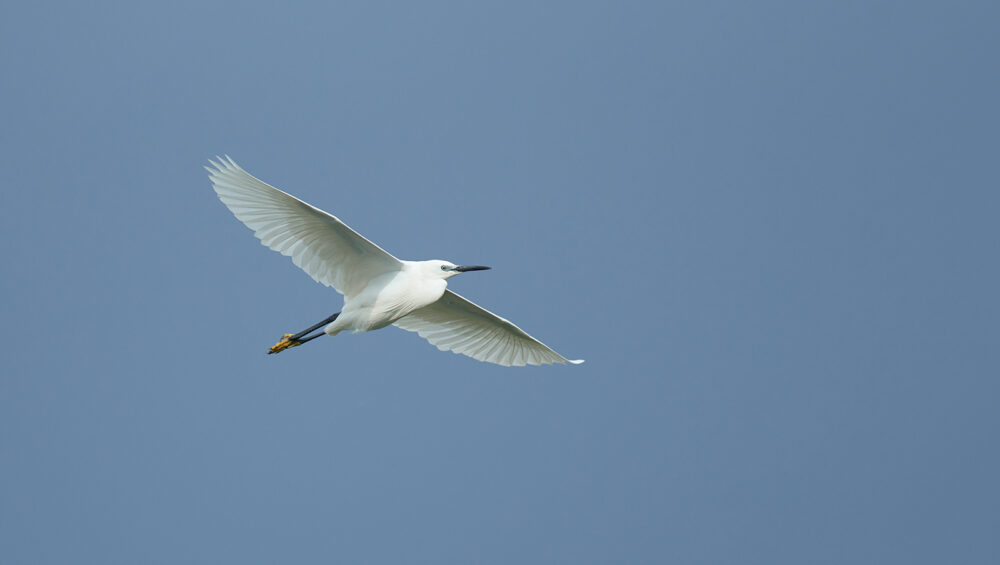
Little Egret

Little Egret – Egretta garzetta

Classification

  • Kingdom: Animalia
  • Class: Aves
  • Order: Pelecaniformes
  • Family: Ardeidae
  • Genre: Egretta
  • Species: Egretta garzetta

Identification characters

The little egret is a medium-sized, slender and elegant lizard with a plumage of immaculate white. Compared to the female, the male is slightly larger. The legs are black, but with yellow toes. The legs are shorter in relation to body length compared to the white egret, and their projection in flight is moderate, and the wings appear centrally inserted. During the breeding season they develop two elegant feathers on the back of their heads, much sought after in the past as ornaments. The beak is black, the lorum is bluish-grey most of the year, and in the courtship period it takes on a reddish tinge. Outside the colonies it is usually silent and only when it takes flight does it emit a hoarse, seed crow-like sound. Birds in colonies make loud, gargling sounds.

Distribution

The range of the species is the whole European continent except the Scandinavian Peninsula. It winters on the African continent.
The European population of the species is relatively small, ranging from 66 700 to 84 800 pairs. Although the population showed an upward trend between 1970 and 1990, it is now in slight decline.
In Romania, the White Egret population is around 4 000-8 000 pairs. Larger flocks are present in Italy, France, Spain, Azerbaijan and Russia. Between 20,000 and 50,000 individuals can be seen on Romanian territory during passages.

Living environment and biology of the species

For nesting they prefer marshy areas, deltas and ponds with tree stands. It is the quietest of the egrets. It nests in mixed colonies with other species of terns and cormorants. Maximum known longevity is 22 years.
It hunts by lying in wait or moving carefully in shallow water. They feed on fish up to 10 cm long, amphibians and other small aquatic animals (especially insects and molluscs). During nesting, parents travel between 7 and 13 km from the colony daily to feed.
A summer visitor to our country, it arrives in early April from wintering quarters. It builds its nest, made of twigs and reeds, on willows and sometimes in reeds or thick shoots near ponds. Both parents participate in nest building. In colonies, nests are placed up to 4 m apart. Between the second half of May and the first half of June, the female lays 3-4 greenish eggs. Incubation lasts 21-25 days and is carried out by both parents. The chicks remain in the nest for around 30 days. They leave the nest before they can fly, climbing skilfully through the branches. They continue to be fed by their parents until they are 40 days old, when they become independent.

Threats and conservation measures

The Great Egret is threatened by habitat loss and alteration, pollution and management
management, poaching.
In order to conserve white egret populations, it is recommended to respect restrictions in riparian areas, manage litter in wetlands, protect nesting and feeding sites, conserve woodlands in the vicinity of aquatic habitats, maintain and conserve reedbeds with permanent water, protect colonies, prohibit burning reeds. Forestry work of any kind should be carried out outside the species’ breeding season. Only selective and low-toxicity agrochemicals should be used on neighbouring land. Measures to prevent drying out and sudden artificial changes in the water regime in wetlands are of the utmost importance.
Research is needed to assess the impact of the species on commercially exploited resources (geese, crustaceans, molluscs) and to harmonise conservation objectives with the activities of the affected sectors.
Hunting legislation needs to be respected, and good cooperation between conservation organisations, hunting organisations, the gendarmerie and the Environment Guard is desirable.
Studies on various aspects of the biology of the species, the inventory of current and potential breeding areas, the identification of migration, feeding and aggregation areas are useful and should be promoted.

Bibliography

  • Fântână Ciprian, Kovács Istvan, Benkő Zoltán, Daròczi Szilárd, Domșa Cristian, Veres-Szászka Judit (editori), 2022, Atlas al speciilor de păsări de interes comunitar din România, ediția a II-a – Iubește păsările, salvează natura!, Proiect finanțat din Fondul European de Dezvoltare Regională prin Programul Operațional Infrastructură Mare 2014-2020, Ministerul Mediului, Apelor și Pădurilor- Direcția Biodiversitate, coordonare științifică Societatea Ornitologică Română și Asociația pentru Protecția Păsărilor și a Naturii Grupul Milvus, produs de EXCLUS PROD SRL, p. 102-103;
  • Lars Svensson, Hakan Delin, 1988, Photographic guide to the birds of Britain and Europe, Herons, storks and ibises p. 30, Chancellor Press, London
  • Svensson (text și hărți), 2017, Ghid pentru identificarea păsărilor. Europa și zona mediteraneană, traducerea și adaptarea în limba română: Societatea Ornitologică română, Emanuel Ștefan Baltag, Sebastian Bugariu, Alida Barbu, p.82;
  • Radu Dimitrie, 1983, Mic atlas ornitologic – Păsările lumii, Editura Albatros, București, p. 660;
  • https://pasaridinromania.sor.ro/ Ornitodata | Egretă mică (sor.ro)

Great White Egret

Great Egret – Ardea alba

Classification

  • Kingdom: Animalia
  • Class: Aves
  • Order: Pelecaniformes
  • Family: Ardeidae
  • Genre: Ardea
  • Species: Ardea alba

Identification characters

The Great Egret is a very large, uniformly white-plumaged starling. Body length can reach 100 cm and wingspan 170 cm. It differs from the lesser egret not only in its larger waist, but also in its attitude in flight, with its wings set in towards the forewing having slower but more imposing beats and its longer legs projecting far behind the tail. The beak is yellowish, as are the tibia and part of the tarsi. The toes are dark. In the past, the white egret was hunted for its ornamental feathers.

Distribution

The species has a wide distribution on all continents except cold areas. In the northern hemisphere, the distribution extends to the northern limit of the temperate zone. In Europe the range is restricted and fragmented. It winters in the Mediterranean area and in Africa. The European population is relatively small, 20 700- 34 900 pairs.
In Romania it is a breeding species. The population in Romania, of which a large part is in the Danube Delta, has been estimated at 400-1 000 breeding pairs. Between 123 and 2 150 individuals winter in our country, and between 5 000 and 10 000 individuals can be seen during the passage. In the rest of the country, the great egret is found mainly in southern Moldavia, the south and west of the country (Banat and Crișana), but also in wet areas with reed beds and along large rivers.

Living environment and biology of the species

The Great Egret prefers puddles and wetlands over large areas with reed beds, flooded meadows, canals, ponds. Feeds in shallow water, in flooded areas with rich vegetation, marshes, on the banks of streams, canals. Diet generally consists of fish and aquatic insects, but can also frequently be seen on dry land, where it hunts small mammals, baby birds, lizards or terrestrial insects. Maximum known longevity is 13 years and 9 months. It is a partially migratory species. Juveniles leave nesting areas as early as July. They migrate in the autumn months to southern Europe, but in mild winters some individuals can be seen in our area, especially on the ponds in the south and south-east of the country. Returns to nesting areas from late February.
It nests predominantly in flooded reedbeds at low elevations, but sometimes also on low willows or other trees, in sparse colonies with scattered nests, sometimes adjoining other colonies of lizards. The two parents participate in the construction of the nest, made of branches and reeds. The female lays 3-5 eggs between the second half of April and early June. Incubation lasts 25-27 days and is carried out by both parents. The chicks remain in the nest for around 30 days, but continue to be fed by the parents until 42 days, when they become completely independent of them.

Threats and conservation measures

The Great Egret is threatened by habitat loss and alteration, pollution and management
management, poaching.
In order to conserve white egret populations, it is recommended to respect restrictions in riparian areas, manage litter in wetlands, protect nesting and feeding sites, conserve woodlands in the vicinity of aquatic habitats, maintain and conserve reedbeds with permanent water, protect colonies, prohibit burning reeds. Forestry work of any kind should be carried out outside the species’ breeding season. Only selective and low-toxicity agrochemicals should be used on neighbouring land. Measures to prevent drying out and sudden artificial changes in the water regime in wetlands are of the utmost importance.
Research is needed to assess the impact of the species on commercially exploited resources (geese, crustaceans, molluscs) and to harmonise conservation objectives with the activities of the affected sectors.
Hunting legislation needs to be respected and good cooperation between conservation organisations, hunting organisations, the gendarmerie and the Environment Guard is desirable.
Studies on various aspects of the biology of the species, the inventory of current and potential breeding areas, the identification of migration, feeding and aggregation areas are useful and should be promoted.

Bibliography

  • Fântână Ciprian, Kovács Istvan, Benkő Zoltán, Daròczi Szilárd, Domșa Cristian, Veres-Szászka Judit (editori), 2022, Atlas al speciilor de păsări de interes comunitar din România, ediția a II-a – Iubește păsările, salvează natura!, Proiect finanțat din Fondul European de Dezvoltare Regională prin Programul Operațional Infrastructură Mare 2014-2020, Ministerul Mediului, Apelor și Pădurilor- Direcția Biodiversitate, coordonare științifică Societatea Ornitologică Română și Asociația pentru Protecția Păsărilor și a Naturii Grupul Milvus, produs de EXCLUS PROD SRL, p. p.104-105;
    • Lars Svensson, Hakan Delin, 1988, Photographic guide to the birds of Britain and Europe, Herons, storks and ibises p. 30, Chancellor Press, London
  • Svensson (text și hărți), 2017, Ghid pentru identificarea păsărilor. Europa și zona mediteraneană, traducerea și adaptarea în limba română: Societatea Ornitologică română, Emanuel Ștefan Baltag, Sebastian Bugariu, Alida Barbu, p.82;
  • Radu Dimitrie, 1983, Mic atlas ornitologic – Păsările lumii, Editura Albatros, București, p. 67;
  • https://pasaridinromania.sor.ro/ Ornitodata | Egretă mare (sor.ro)

Kingfisher

Common Kingfisher- Alcedo atthis

Classification

  • Kingdom: Animalia
  • Class: Aves
  • Order: Coraciiformes
  • Family: Alcedinidae
  • Genre: Alcedo
  • Species Alcedo atthis

Identification characters

It is a small bird, very beautifully coloured, with a body length of 18 cm.
It weighs 34-46 grams. Large head, long beak, broad wings, short tail. Legs are short, bright red and grey in juveniles. Crests and wings are greenish-blue, backs and tails deep blue, with shades varying according to the direction in which light rays strike the plumage. The belly is reddish orange. The cheeks have a scarlet patch. The male’s bill is greyish black, while the female’s is red at the base of the mandible. It stands upright on its stand. In flight it emits a short, sharp whistle.

Distribution

The Common Kingfisher nests in territories from the western Palearctic to Japan, Sri Lanka, Indochina, Sulawesi and the Solomon Islands. In Europe it is found south of latitude 60°N.
Key populations nest in Russia, the UK, Spain, Italy, Poland and Romania. The breeding population in Europe ranges from 97 500 to 167 000 pairs, representing 25% of the global population. A decline of 30-49% over 13 years is estimated over three generations.
In winter, the eastern European flocks migrate to southern and western Europe, with the largest populations in Ireland, the UK, France, Spain and Italy. In Romania it is a resident species, spread throughout the country. The breeding population in Romania is between 5,000 and 10,000 pairs.

Living environment and biology of the species

The species nests in the western Palearctic at both high and mid latitudes and is widespread in continental and oceanic climates, temperate, boreal and steppe regions.
It prefers habitats with clear unfrozen, still or slow-flowing water, small fish and roosting sites. During breeding season prefers fresh water to brackish or salt water. For nesting it chooses steep, sandy banks of streams, small rivers and canals.
Feeds on small freshwater and marine fish and aquatic insects. Sometimes it also eats crustaceans, molluscs, terrestrial insects or amphibians. Its daily food intake is equivalent to 60% of its weight. It lurks on branches above the water and dives head down to catch prey. Sometimes it flies briefly over the water and then attacks. It is very skilful at catching fish, which is why in the Danube Delta area it is also called Ivan the fisherman. Maximum longevity is 21 years.
It is a monogamous and territorial species. It is the male that initiates the mating ritual. He follows the female and offers her food. The nest is dug by both sexes in the banks in the form of a gallery about 1m long, with a wider, round chamber at the end, in which the female lays in April-May a clutch of 6-7 eggs, to be hatched in turn by both parents. The size of an egg is 22×19 mm. The incubation period is 19-21 days. Both sexes hatch during the day and only the female at night. The chicks remain in the nest for 24-27 days. As they grow, the chicks advance to the edge of the tunnel to be fed. Under favourable conditions the species can lay two or even three eggs a year.

Threats and conservation measures

Habitat loss and alteration through stream regulation, destruction of the natural banks where they prefer to nest, damming, anthropogenic disturbance, as well as pollution and poor water management are all factors that threaten blue gull populations.
Conservation requires restrictions in riparian and coastal areas, avoiding construction in the vicinity of wetlands, and not cutting down trees and reeds at the water’s edge. River regulation works should be under control and the exploitation and excavation of loess and sand from the water’s edge should be prohibited. Waste and sewage management in wetlands must be carried out, and a minimum 1.5 m uncultivated strip must be maintained between cultivated land and wetlands, where the use of chemicals is strictly prohibited. Along riversides, the conservation and, where appropriate, restoration of forests and wetland vegetation is recommended, with particular attention to protected riparian areas. The use of agrochemicals should be monitored and the use of selective and low toxicity agrochemicals should be encouraged. In wetlands, drought and sudden artificial changes in water regime should be avoided. During the nesting period, sport fishing should be controlled to reduce disturbance.
It is useful and worthwhile to promote studies on various aspects of the biology of the species, to carry out an inventory of current and potential breeding areas, and to identify migration, feeding and aggregation areas.

Bibliography

  •  Fântână Ciprian, Kovács Istvan, Benkő Zoltán, Daròczi Szilárd, Domșa Cristian, Veres-Szászka Judit (editori), 2022, Atlas al speciilor de păsări de interes comunitar din România, ediția a II-a – Iubește păsările, salvează natura!, Proiect finanțat din Fondul European de Dezvoltare Regională prin Programul Operațional Infrastructură Mare 2014-2020, Ministerul Mediului, Apelor și Pădurilor- Direcția Biodiversitate, coordonare științifică Societatea Ornitologică Română și Asociația pentru Protecția Păsărilor și a Naturii Grupul Milvus, produs de EXCLUS PROD SRL, p. 326-327;
  • Svensson (text și hărți), 2017, Ghid pentru identificarea păsărilor. Europa și zona mediteraneană, traducerea și adaptarea în limba română: Societatea Ornitologică română, Emanuel Ștefan Baltag, Sebastian Bugariu, Alida Barbu, p.238;
  • Radu Dimitrie, 1983, Mic atlas ornitologic – Păsările lumii, Editura Albatros, București, p. 171;
  • https://pasaridinromania.sor.ro/ Ornitodata | Pescăraş albastru (sor.ro)