Starling

Common Starling – Sturnus vulgaris

Classification

  • Kingdom: Animalia
  • Class: Aves
  • Order: Passeriformes
  • Family: Sturnidae
  • Genre: Sturnus
  • Species: Sturnus vulgaris

Identification characters

The body is black, with lighter shading to the back feathers and intense green and
purple on the head and chest. It imitates the songs of other birds.

Distribution

It is a widespread species in the northern hemisphere. Native to Eurasia, it is found throughout Europe, North Africa (from Morocco to Egypt), India (mainly in the north, but steadily expanding southwards), Nepal, the Middle East, including Syria, Iran, Iraq and northwest China. Birds in harsh winter regions migrate. Large numbers of birds from northern Europe winter in Russia and Ukraine and migrate southwest and southeast. In North America, northern populations migrate in autumn from Canada to the southwestern United States. Grackles in southern and western Europe and south of the 40th parallel are predominantly sedentary. In Romania, the population of starlings ranges from 2,749,791 to 3,584,757 breeding pairs.

Living environment and biology of the species

The starlings prefer urban or suburban man-made areas where man-made structures and trees provide nesting sites. Birds usually feed in grassy areas such as farmland, pastures, sports fields or airfields, where short grass makes feeding possible. Outside settlements they prefer open woodlands with old, scrubby trees. Their ability to adapt to a wide variety of habitats has allowed them to disperse and establish in different parts of the world, so that the species occurs in a very wide range of habitats, from coastal wetlands to alpine forests, where it reaches altitudes of over 1 900 m. The starling is a very gregarious bird, especially in autumn and winter. Flocks are highly variable in size and noisy, and are used to defend against predator attacks. They perform expanding and contracting movements, constantly changing shape, To rid themselves of parasites, starlings use formic acid from ants, which they spread on their feathers with their beaks.

It reaches a maximum longevity of 22 years and nine months in the wild. Reaches sexual maturity at the age of one year. Grackles are insectivorous birds and feed on flies, moths, dragonflies, grasshoppers, trichopters, beetles, bees, wasps, ants, etc., even spiders. Another food source is earthworms, snails and even small invertebrates such as frogs and lizards. They can also consume grains, seeds, fruit, nectar and food waste. Grackles, if they have periods without access to food or if there is a reduction in the hours of daylight available for feeding, compensate for this deficit by increasing their body mass by depositing fat, It is a monogamous species.

It nests from April onwards in various cavities, such as hollows, crevices in stones, and in localities it uses any closed shelter it can find (butterflies in walls, under roofs, in chimneys, etc.). It lays two eggs per year, 3-7 eggs each, light blue in colour, 26.5 x 34.5 mm in size. The two partners hatch in turn, the incubation period being 12-14 days. The chicks are cared for by both parents for 3 weeks.

Threats and conservation measures

Threats include habitat alteration, fragmentation and loss, but also pollution, contamination by agricultural products, hunting and poaching. Conservation measures need to be taken, such as: matching forestry work to the biology of the species to avoid disturbance at critical times, banning deforestation resulting in reduced forest size and land use change, reducing the use of insecticides and herbicides in agriculture and forestry. Where necessary, substances with minimal toxicity and persistence should be applied to breeding grounds only outside the breeding season. Other measures are the maintenance of native forests, maintenance and development of a mosaic landscape, corridors between areas of spontaneous grassland, including scattered trees, tree lines and groups of non-productive trees. maintenance of at least 30 trees/ha for nesting in their hollows, installation of artificial nests. It is recommended to stop hunting and control poaching. Inventory of breeding, migration, feeding and aggregation areas important for the conservation of the species is necessary. It is also useful to promote studies on the biology of the species.

Bibliography

  • Fântână Ciprian, Kovács Istvan, Benkő Zoltán, Daròczi Szilárd, Domșa Cristian, Veres- Szászka Judit (editors), 2022, Atlas of bird species of community interest in Romania, 2nd edition – Love birds, save nature!, Project financed by the European Regional Development Fund through the Large Infrastructure Operational Programme 2014-2020, Ministry of Environment, Water and Forests – Biodiversity Directorate, scientific coordination Romanian Ornithological Society and Association for the Protection of Birds and Nature Milvus Group, produced by EXCLUS PROD SRL, p. 536.
    Radu Dimitrie, 1983, Small Ornithological Atlas – Birds of the World, Albatros Publishing House, Bucharest, p. 242.

Golden Oriole

Eurasian Golden Oriole – Oriolus oriolus

Classification

  • Kingdom: Animalia
  • Class: Aves
  • Order: Passeriformes
  • Family: Oriolidae
  • Genre: Oriolus
  • Species: Oriolus oriolus

Identification characters

The male is yellow with black wings and tail. The female is greenish with green wings and tail.
darker.

Distribution

The Eurasian Golden Oriole is a widespread summer visitor to Europe. It is only absent from the northern part of the continent. The species also nests from western Asia to Mongolia and China, India and northwest Africa. Apart from central India, where it may be sedentary, the species migrates to central and southern Africa, and populations in the Indian area move to winter in the southern peninsula. The European population ranges from 4,370,000 to 8,020,000 breeding pairs, representing more than half of the species’ global population. Between 1982 and 2013 the European population of the European tern was stable. The Romanian population of the barn owl is between 400,000 and 800,000 breeding pairs, with a decreasing trend.

Living environment and biology of the species

In Europe, the Eurasian Golden Oriole nests in a variety of habitats, but prefers riparian woodlands, open deciduous forests or even larger gardens. In the eastern part of Europe it can also live in more compact forests, mixed forests or coniferous forests. It avoids treeless areas, but can fly into such areas to feed. In wintering quarters it can be found in habitats such as semi-arid or wet forests, tall forests, mosaics of forest and savannah or savannah only.
It is a shy bird, always hiding in the foliage. Migration takes place at night. The maximum longevity reached is 14 years and eight months. It is a predominantly insectivorous species, but also feeds on cherries and other fruits. Prey is mainly foraged in treetops, but also in foliage or picked right off the ground. It can water from the air, like swallows. They return to their wintering quarters in May-June.

The nest is built by the female and is similar to a hammock. The nest is cup-shaped and is constructed of materials such as reed moss, grass, moss, pieces of cloth, paper, tree bark, lichen, etc. On the inside it is lined with feathers or wool and horsehair, when available. The female lays a clutch of 2-5 white eggs with reddish-brown splashes. Incubation lasts 16-18 days. The chicks fly from the nest after the parents feed them intensively for 17-18 days. Egg incubation is mainly carried out by the female, sometimes replaced by the male. After leaving the nest, they stay with the adults for another 10-14 days. A pair lays one clutch in a breeding season.

Threats and conservation measures

Threats identified are habitat fragmentation and loss, and pollution. Conservation measures are recommended: Matching forestry work to the biology of the species to avoid disturbance during critical periods, maintaining a mosaic of habitats with the presence of tree and shrub patches in open agricultural areas, maintaining and accentuating corridors between areas of spontaneous grassland including trees, tree lines and scattered non-productive tree groups, conservation of forests in the vicinity of aquatic habitats, reduction of insecticide and herbicide use in agriculture and forestry, prevention of bush and forest fires. An inventory of breeding, migration, foraging and aggregation areas important for the conservation of the species is needed. It is also useful to promote studies on the biology of the species.

Bibliography

  • Fântână Ciprian, Kovács Istvan, Benkő Zoltán, Daròczi Szilárd, Domșa Cristian, Veres-Szászka Judit (editors), 2022, Atlas of bird species of community interest in Romania, 2nd edition – Love birds, save nature!, Project financed by the European Regional Development Fund through the Large Infrastructure Operational Programme 2014-2020, Ministry of Environment, Water and Forests – Biodiversity Directorate, scientific coordination Romanian Ornithological Society and Association for the Protection of Birds and Nature Milvus Group, produced by EXCLUS PROD SRL, p. 540.
    Radu Dimitrie, 1983, Small Ornithological Atlas – Birds of the World, Albatros Publishing House, Bucharest, p. 244.

Bearded Tit

Bearded Reedling– Panurus biarmicus

Classification

Kingdom: Animalia
Class: Aves
Order: Passeriformes
Family: Panuridae
Genre: Panurus
Species: Panurus biarmicus

Identification characters

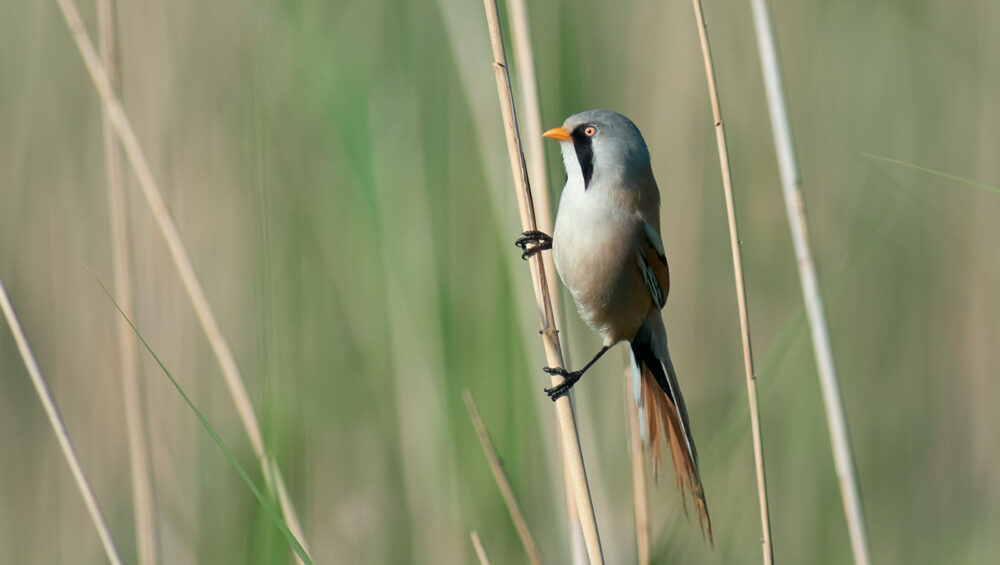
The adult is small, with a body length of 14-15 cm. Characteristic thirsty flight with irregular wing beats. Beak is conical with a pointed tip. The colour is yellow-violet, the head bluish, with a black moustache, which is missing in females.

Distribution

The Bearded Reedling has a large nesting range, including most of Europe and Asia. The population in Europe ranges from 232,000 to 437,000 nesting pairs. It is a sedentary species that can travel short distances due to the cold in winter. It sometimes occurs in northern Africa and the Arabian Peninsula. The Iberian Peninsula is a favourite wintering area. In Romania, the reed bunting is found in the Danube Delta and in the reedy wetlands of the rest of the country. In Romania, the breeding population of reed bunting is between 19,605 and 40,465 pairs.

Living environment and biology of the species

The Bearded Reedling nests in wet areas with compact reed beds, characteristic of freshwater or brackish lakes and marshes. To a large extent, nesting territories overlap with territories used during autumn and winter. Outside the nesting season they form large flocks of up to 200 individuals. Maximum longevity is seven years. In summer it feeds on various invertebrates, especially insects. In late autumn and winter it eats seeds, and in spring it eats petals or buds.

The reed warbler is a diurnal species. It is monogamous. Pairs nest in small colonies. Its song apparently serves to attract a mate and maintain the pair. The nest is made of various plant materials and is placed on reed stalks between 30 and 125 cm above the water. Both partners participate in the construction of the nest. The female lays a clutch of 4-8 eggs in mid-April. Incubation lasts 10-14 days and is carried out by both partners. After hatching, the chicks are cared for for 12-13 days by both parents until they begin to fly. In a breeding season, a pair may lay 2-4 eggs in a breeding season.

Threats and conservation measures

Populations of reed can be threatened by habitat loss and alteration, pollution and poor water management. Necessary conservation measures include: respecting building restrictions in riparian areas, maintaining or restoring vegetation to an ecologically optimal level for the species, prohibiting the burning of riparian vegetation, including prohibiting the burning of reedbeds, preserving reedbeds with permanent water as characteristic habitat, measures to avoid eutrophication and sedimentation of wetlands. Between cultivated land and wetlands it is recommended to maintain uncultivated strips of at least 1.5 m, where the use of chemicals is strictly prohibited.

Only selective and low-toxicity agrochemicals should be used on neighbouring land and treated seeds should not be used, and organic farming should be encouraged. Water level management in aquatic ecosystems should be applied in accordance with the ecological needs of the species. It is important to inventory breeding areas, identify migration, feeding and aggregation areas, and promote studies on various aspects of the species’ biology.

Bibliography

  • Fântână Ciprian, Kovács Istvan, Benkő Zoltán, Daròczi Szilárd, Domșa Cristian, Veres-Szászka Judit (editors), 2022, Atlas of bird species of community interest in Romania, 2nd edition – Love birds, save nature!, Project financed by the European Regional Development Fund through the Large Infrastructure Operational Programme 2014-2020, Ministry of Environment, Water and Forests – Biodiversity Directorate, scientific coordination Romanian Ornithological Society and Association for the Protection of Birds and Nature Milvus Group, produced by EXCLUS PROD SRL, p. 502.
    Svensson (text and maps), 2017, Guide to bird identification. Europe and the Mediterranean area, translation and adaptation into Romanian: Romanian Ornithological Society, Emanuel Ștefan Baltag, Sebastian Bugariu, Alida Barbu, p. 346.
    Radu Dimitrie (1983)- Mic atlas ornitologic – Pajările lumii, Editura Albatros, București, p. 214.

Blackcap

Eurasian Blackcap-Sylvia atricapilla

Classification

  • Kingdom: Animalia
  • Class: Aves
  • Order: Passeriformes
  • Family: Sylviidae
  • Genre: Sylvia
  • Species: Sylvia atricapilla

Identification characters

It is 15 cm in size. It is a bird with a melodious song. The body is grey-brown. The breast is black in the male,
and scarlet in the female.

Distribution

The Eurasian Blackcap is a breeding species throughout most of Europe and western Asia, with the eastern limit of the species near the Mongolian border. It is a migratory species in the cold areas of central and northern Europe and sedentary in the western and southern parts of the European continent. The species is also present and also sedentary in northern Africa and a few nearby islands. Migratory specimens migrate to the Mediterranean Sea and to northern, western and eastern Africa. In Romania, the Black-headed Sylvia population ranges from 2 130 766 to 2 639 637 breeding pairs.

Living environment and biology of the species

While nesting, the black-headed godwit can be found in forest habitats, being characteristic of deciduous forests, but during this period it can also be found in localities, where there are orchards, parks or gardens rich in trees and bushes. In winter it is a species often associated with fruit-rich sites, including olive groves, gardens or palm plantations. Eurasian Blackcap is an omnivorous species, but feeds largely on insects. During the breeding season, its diet includes flies, caterpillars, mayflies, dragonflies, moths, beetles and spiders, all of which are mainly collected from leaves and branches or even caught in flight. When the young are large, towards autumn, they also start feeding on seeds and fruit. In winter it is a frequent visitor to human-made feeders, and there are even changes in the migration of some western European populations, brought about by the constant presence of this food source in the cold season.

The breeding season lasts from April to August, but varies across the range, with some areas having populations where a pair consistently produces two litters of young in a year. Early in the season, the male begins building several nests, of which the female chooses one in which to lay her young.

The chosen nest is completed by both partners from grass, twigs and roots and is cup-shaped. The inside is lined with hairs and grass hairs. The nest is usually placed in a bush or shrub, in small trees or in dense vegetation, fern bushes being preferred. The female lays a clutch of 2-7 dark-spotted grey-brown eggs, 19.7-14.7 mm in size. Incubation lasts between 10 and 16 days and is carried out by both partners. After hatching, the chicks are fed by the two adults and can fly from the nest after 10-15 days. They are not fully independent and need parental care for another 2-3 weeks.

Threats and conservation measures

Threats include habitat alteration, fragmentation and loss, poor forest management, pollution, and the need to ban new urban development, including scattered settlements in forest habitats important for breeding, feeding or resting, to match forestry work to the biology of the species to avoid disturbance during critical periods, to maintain undergrowth in logged forests, and to maintain and enhance corridors between areas of spontaneous grassland including trees. Scattered lines of trees and groups of non-productive trees, maintaining a mosaic of habitats with the presence of tree and shrub stands in open agricultural areas, reducing the use of insecticides and herbicides in agriculture and forestry. Where necessary and in the absence of alternatives, the use of substances with minimal toxicity and persistence should be justified and applied on the breeding grounds of the species only outside the breeding season An inventory of breeding, migration, feeding and aggregation areas important for the conservation of the species should be carried out. It is also useful to promote studies on the biology of the species.

Bibliography

  • Fântână Ciprian, Kovács Istvan, Benkő Zoltán, Daròczi Szilárd, Domșa Cristian, Veres- Szászka Judit (editors), 2022, Atlas of bird species of community interest in Romania, 2nd edition – Love birds, save nature!, Project financed by the European Regional Development Fund through the Large Infrastructure Operational Programme 2014-2020, Ministry of Environment, Water and Forests – Biodiversity Directorate, scientific coordination Romanian Ornithological Society and Association for the Protection of Birds and Nature Milvus Group, produced by EXCLUS PROD SRL, p. 460.
    Radu Dimitrie, 1983, Small Ornithological Atlas – Birds of the World, Albatros Publishing, Bucharest, p. 86.

Blackbird

Common Blackbird- Turdus merula

Classification

  • Kingdom: Animalia
  • Class: Aves
  • Order: Passeriformes
  • Family: Turdidae
  • Genre: Turdus
  • Species: Turdus merula

Identification characters

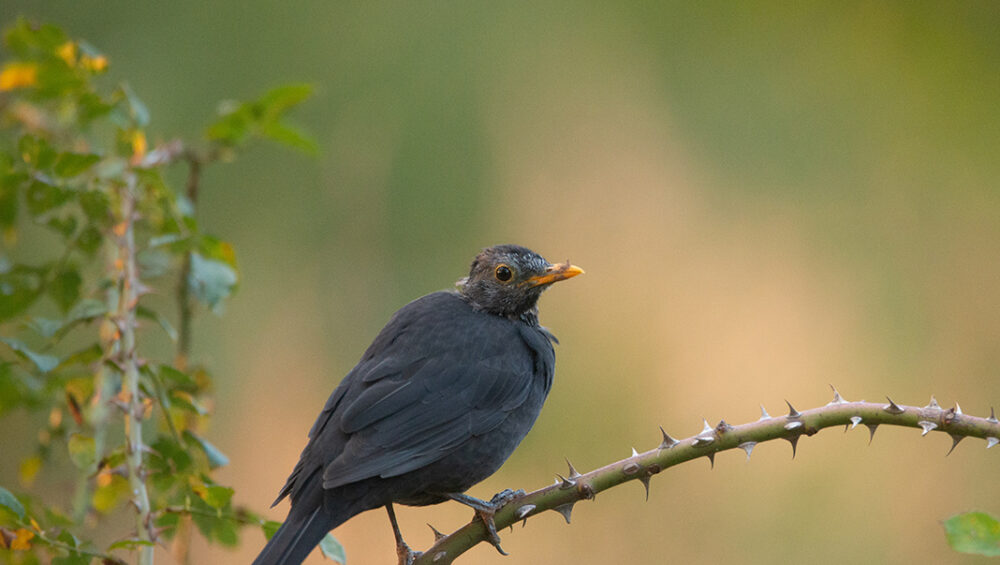
The male is black, the female dark brown. In spring and autumn, the male has a yellow beak and periorbital ring.

Distribution

It has a wide range, including Europe, Asia and North America. It has been introduced into Australia and New Zealand. It has populations that are resident, migratory or partially migratory, the latter being represented by northern European populations that move south during the autumn. In Romania it is a common species in parks, gardens and forests, regardless of altitude. The breeding population in Romania ranges from 2 623 894 to 3 192 900 pairs and is on an upward trend.

Living environment and biology of the species

Blackbirds are found in both urban parks and mountain forests. It is found in dense forests as well as in grasslands, in various crops, in some wetlands, and in most urban areas. It tolerates cold, windy and wet areas better than dry ones. Avoids areas that do not provide shelter more than 100-200 m away. Off-season breeding may be gregarious. Maximum longevity in the wild is 21 years and eight months. Reaches sexual maturity at the age of one year.

Food consists of insects and earthworms, but in autumn and winter they eat fruit and seeds. It feeds on the ground or in trees and bushes, foraging under leaves at the edge of forests or even in a 5-7 cm thick layer of snow. Exceptionally it feeds on small fish, lizards and newts. During the winter it can often be found at feeders. It is a monogamous species. The nesting season begins in mid-April. Males engage in intense territorial battles. The female lays a clutch of 2-6 blue-green eggs with brownish spots in a nest in bushes at the base of branches in trees or shrubs. The female builds the nest with materials brought by the male. It can also nest in places close to humans, such as flower pots, unopened mailboxes, burlons, windowsills, firewood stores, abandoned chimneys. Occasionally it can also nest on the ground.

The nest is shaped like a deep cup, built of twigs, straw, usually with moss at the base, and plastered with mud on the inside in which fine strands of vegetation are caught. The cages that are in the localities may also contain pieces of paper or even strips of plastic bags as building material. The young are incubated for 12-14 days by the female only, and after 11-14 days the young fly out of the nest. During incubation the male may replace the female at hatching, but only for short periods of time. The chicks are still fed by the parents for three weeks after leaving the nest until they are completely independent of them. A pair frequently lays two eggs in a breeding season.

Threats and conservation measures

Threats are habitat alteration, fragmentation and loss, habitat alteration and loss due to agricultural activities or land use change, contamination by agricultural products, poaching Conservation measures include: matching forestry work to the biology of the species to avoid disturbance during critical periods, maintaining the understory layer in logged forests prohibiting deforestation resulting in a decrease in forest size and land use change, maintaining and increasing the extent of native forests, aiming for the highest level of structural and species diversity, promoting management types that favour forest heterogeneity, maintaining a mosaic of habitats with the presence of tree stands and shrubs in open, agricultural areas.

It is important to maintain and emphasise corridors between areas of spontaneous grassland including trees, tree lines and scattered groups of non-productive trees. The use of insecticides and herbicides in agriculture and forestry should be greatly reduced and, where necessary and in the absence of alternatives, the use of substances with minimal toxicity and persistence should be justified and applied on the species’ breeding grounds only outside the breeding season.

Importance should be attached to preventing and penalising illegal bush fires, control and enforcement of hunting legislation through cooperation between environmental organisations, hunting organisations, the gendarmerie and the anti-poaching environmental guard. An inventory is needed of breeding, migration, feeding and aggregation areas important for the conservation of the species. It is also useful to promote studies on the biology of the species.

Bibliography

  • Fântână Ciprian, Kovács Istvan, Benkő Zoltán, Daròczi Szilárd, Domșa Cristian, Veres-Szászka Judit (editors), 2022, Atlas of bird species of community interest in Romania, 2nd edition – Love birds, save nature!, Project financed by the European Regional Development Fund through the Large Infrastructure Operational Programme 2014-2020, Ministry of Environment, Water and Forests – Biodiversity Directorate, scientific coordination Romanian Ornithological Society and Association for the Protection of Birds and Nature Milvus Group, produced by EXCLUS PROD SRL, p. 420.
    Radu Dimitrie, 1983, Small Ornithological Atlas – Birds of the World, Albatros Publishing House, Bucharest, p. 195.

Penduline Tit

Penduline Tit – Remiz pendulinus

Classification

  • Kingdom: Animalia
  • Class: Aves
  • Order: Passeriformes
  • Family: Remizidae
  • Genre: Remiz
  • Species: Remiz pendulinus

Identification characters

It is one of the species that builds perhaps the most interesting nest of all bird species in Romania. The nest, shaped like a bagpipe, has an entrance passageway at the top and is woven from fine bark and seed threads of downy trees such as willow and poplar. It is a small bird (11 cm long). The beak is tapered and pointed. The adult is brown on the back, greyish-yellow on the head and tail, reddish on the breast and belly. The black eye mask is present in both sexes, the male is broader.

Distribution

The Penduline Tit, also called the stonechat, nests in central and southern Europe and as far west as Kazakhstan. It is absent from northern Eurasia, Britain and much of France. It is a migratory species, wintering in the southern and central parts of its range. In the southern part of its range it is a sedentary bird. The world population is estimated at over 1,400,000 and is increasing. In Romania, the breeding population ranges from 14,771 to 37,173 pairs.

Living environment and biology of the species

The Penduline Tit is found in reedy areas near lakes, rivers and marshes. Northern populations migrate to Mediterranean countries in winter. In August-September the autumn migration begins and the birds return to their nesting grounds in April-May. Maximum longevity is seven years. Reaching sexual maturity at one year. By day they forage in crevices in the bark of trees with their long beaks. Feeds on insects and spiders, but sometimes also consumes flower nectar or various fruits and seeds. The nesting begins in late April. It is a monogamous species. Males build a pear-shaped nest of plant fibres, wool and spider webbing in 12 to 14 days at a height of 3-15 m.

The nest is suspended from a willow, poplar or maple branch, often over water. Males sing near the nest to attract females. The female chooses her mate according to the quality of the nest built. She prefers larger nests. The female begins to work with the male on this preferred nest. If the female does not pay attention to the nest started by the male, the nest is abandoned and the male flies to another place to start a new construction.

The female lays between 5 and 10 matt white eggs. After 13-14 days, the young hatch. 18-24 days after hatching, the young leave the nest. One of the parents, either the male or the female, leaves the nest after the eggs have been laid and the other partner remains to care for the young. Both partners tend to become polygamous.

Each, both male and female, can have up to 6 partners during a breeding season. The male leaves the nest when the female begins laying eggs, starting another nest and another breeding cycle. In order to leave first, the female buries eggs already laid in the nest fluff, thus deceiving the male, who is waiting for the eggs to lay. Quite often both the nest and the clutch are left by both partners. In this situation both partners, the egg-producing female and the nest-building male, use up their energy, with no clear benefit to the species.

Threats and conservation measures

The species may be threatened by habitat loss and alteration, pollution and poor water management. Conservation requires that building restrictions in riparian areas are respected, that wetland vegetation is maintained at an ecologically optimal level for the species, that the burning of riparian vegetation including reed-covered areas is prohibited, that reed beds with permanent water are preserved as characteristic habitat, that waste and wastewater around wetlands are properly managed, that measures are taken to avoid eutrophication and sedimentation of wetlands, and that water level management in aquatic ecosystems takes into account the ecological needs of the species. It is recommended to maintain uncultivated strips of at least 1.5 m between cultivated land and wetlands, where the use of chemicals is strictly prohibited, and to encourage the use of selective and low-toxicity agrochemicals and avoid the use of treated seeds on neighbouring land. Organic production should be encouraged. Last but not least, it is recommended that an inventory be made of breeding areas, migration, feeding and aggregation areas that are important for the conservation of the species, and that studies on various aspects of the species’ biology be promoted.

Bibliography

  • Fântână Ciprian, Kovács Istvan, Benkő Zoltán, Daròczi Szilárd, Domșa Cristian, Veres-Szászka Judit (editors), 2022, Atlas of bird species of community interest in Romania, 2nd edition – Love birds, save nature!, Project financed by the European Regional Development Fund through the Large Infrastructure Operational Programme 2014-2020, Ministry of Environment, Water and Forests – Biodiversity Directorate, scientific coordination Romanian Ornithological Society and Association for the Protection of Birds and Nature Milvus Group, produced by EXCLUS PROD SRL, p. 504.
    Svensson (text and maps), 2017, Guide to bird identification. Europe and the Mediterranean area, translation and adaptation into Romanian: Romanian Ornithological Society, Emanuel Ștefan Baltag, Sebastian Bugariu, Alida Barbu, p. 346.
    Radu Dimitrie (1983)- Mic atlas ornitologic – Pajările lumii, Editura Albatros, București, p.212-21.

Teal

Common Teal- Anas crecca

Classification

  • Kingdom: Aves
  • Order: Anseriformes
  • Family: Anatidae
  • Genre: Anas
  • Species: Anas crecca

Identification characters

It is the smallest of the duck species, as the popular name suggests. The body is 34-38 cm long and the wingspan is 53-59 cm. It weighs 200-450 g. The neck is short, the wings are narrow and pointed. The eye is a shiny green colour in both sexes.
As in all ducks, sexual dimorphism is present in the small duck. Adult male
nestling male has a brown head with green on the side, the green area being bordered by a narrow yellow band. The underside of the tail has a yellow triangular area bordered with black. On the side it has a white horizontal line.
The female is brownish, bordered with black spots.

Distribution

The little duck has a very wide distribution, its range encompassing all of Europe, North America and Asia. It nests in the northern and temperate parts of its range. In Europe, the breeding population of the Lesser Spotted Duck is estimated at 557,000 -915,000 pairs.
In Romania, the Lesser White-fronted Duck can be found mainly in the passage and during winter on natural and artificial lakes, ponds, estuaries, deltas, lagoons and marshes. During the nesting season there are small populations in Transylvania and northern Moldavia, in mountain, depression and coastal water areas.
The number of small nesting ducks in Romania is 0-3 pairs. Between 1,150 and 19,951 winter here and between 200,000 and 300,000 may be seen during passage.

Living environment and biology of the species

During the nesting season, the little ducks gather in flocks. It is a predominantly migratory species. Small sedentary populations occur in the southern part of the range. The autumn migration begins in July and culminates in October-November. They return to their wintering grounds in March-April. In winter can also be found on open water, lakes, deltas, flooded plains.
It is considered one of the fastest flying ducks. It can reach more than 120 km per hour in flight. It lifts off the water very easily in flight, with rapid and frequent wing beats.
It is an omnivorous species. During the nesting period, food is predominantly small invertebrates such as molluscs, crustaceans, adult insects and their larvae. Sometimes they also eat amphibians or smaller fish. In winter it also feeds on aquatic plant seeds and plant debris, frequently coming out of the water to graze or collect seeds from farmland. It is very noisy, especially in flight. During nesting it is active during the day, but in passage and in winter it has a crepuscular or even nocturnal activity.
Nesting habitats are shallow, permanent waters with dense vegetation. Pairs form as early as winter, arriving together in the nesting territory from April. The nest is built on the ground in dense vegetation near the water as a small hollow in the ground, lined with ivy and leaves. The female lays a single clutch per year, consisting of 8-11 greenish-yellow eggs. The male participates very little in raising the young. Brooding lasts 21-23 days, with the young being brooded and following the female into the water a few hours after hatching. They are dependent on the female for 25-30 days, then begin to fly.

Threats and conservation measures

Threats to lesser spotted duck may include habitat loss and alteration, pollution and management
management, hunting.
It is recommended to respect restrictions in riparian and coastal areas, maintain wetland vegetation at an ecologically optimal level, manage waste and wastewater in the area of important habitats for the species, use selective and low toxicity agrochemicals, avoid the use of treated seeds in the vicinity of wetlands, manage water levels in reservoirs according to the needs of the species, creating islands to reduce the risk of predation and to help the species breed in artificial or semi-natural wetlands, banning hunting and poaching, limiting the use of fishing nets to prevent birds from being accidentally caught, inventorying breeding areas, identifying important migration, feeding and crowding areas for the species, promoting studies on the biology of the species.

Bibliography

  • Fântână Ciprian, Kovács Istvan, Benkő Zoltán, Daròczi Szilárd, Domșa Cristian, Veres-Szászka Judit (editori), 2022, Atlas al speciilor de păsări de interes comunitar din România, ediția a II-a – Iubește păsările, salvează natura!, Proiect finanțat din Fondul European de Dezvoltare Regională prin Programul Operațional Infrastructură Mare 2014-2020, Ministerul Mediului, Apelor și Pădurilor- Direcția Biodiversitate, coordonare științifică Societatea Ornitologică Română și Asociația pentru Protecția Păsărilor și a Naturii Grupul Milvus, produs de EXCLUS PROD SRL, p. 30-31;
  • Svensson (text și hărți), 2017, Ghid pentru identificarea păsărilor. Europa și zona mediteraneană, traducerea și adaptarea în limba română: Societatea Ornitologică română, Emanuel Ștefan Baltag, Sebastian Bugariu, Alida Barbu, p.28;
  • Radu Dimitrie, 1983, Mic atlas ornitologic – Păsările lumii, Editura Albatros, București, p. 75;
  • https://pasaridinromania.sor.ro/ Ornitodata | Raţă mică (sor.ro)

Mallard Duck

Mallard Duck- Anas platyrhynchos

Classification

  • Kingdom: Animalia
  • Class: Aves
  • Order: Anseriformes
  • Family: Anatidae
  • Genre: Anas
  • Species: Anas platyrhynchos

Identification characters

One of the most common and best known duck species, considered the ancestor of the domestic duck. 50-60 cm.
Short tail, broad wings, orange legs, dark blue mirror bordered with white. The body being large and stocky, 50-60 cm long, it looks heavy in flight.
Sexual dimorphism is present. Male has metallic green head, white collar, dull yellow bill, purplish-brown breast, black hindquarters with central codal feathers curled, rest of body light grey. Females are brownish in colour, so are very well camouflaged when brooding.

Distribution

The Mallard Duck has a very wide range. It is found throughout most of the northern hemisphere, from the subarctic to the tropics, in Europe, Asia, East Africa, North and Central America. In Europe, the breeding population is about 2 850 000 – 4 610 000 pairs.
In Romania it can be found in most aquatic areas corresponding to its preferred habitat type, especially those at low and medium altitudes. The population of the Great Bustard in Romania is 76 662-146 831 breeding pairs. Between 54 397 and 228 791 individuals can be observed in winter.

Living environment and biology of the species

It is a species found in a variety of habitats, from tundra to subtropical, with slow-flowing or still, relatively sheltered waters, estuaries and deltas, lagoons, shallow water sea coasts, lakes, rivers, ponds and puddles, especially in shallow waters with submerged or floating vegetation. Generally avoids deep or exposed waters.
Predominantly migratory species, but some populations are sedentary. Wintering and nesting territories overlap for many populations.
It is an omnivorous and opportunistic species. Food consists of plant debris, leaves, tubers, rhizomes, roots, seeds, insects and their larvae, snails, crustaceans, tadpoles and even small fish. It is a very active species at night. They gather in large groups outside the nesting season. Migrates in flocks. In spring migration flocks are predominantly pairs. In February the pairs begin to look for nesting sites.
Pairs nest separately, but may sometimes form colonies. They nest on the ground in dense vegetation, under boulders, in overhangs or at the base of bushes. Nesting is also common on plains or in reeds. After mating, the male leaves the female and joins other males, waiting for the breeding season, which begins in June. Sometimes they may stay with the female for a second breeding when the first nest has been destroyed. Laying of the clutch takes place from February (in warmer areas). The clutch consists of 8-14 greenish or blue-green eggs, which are incubated for 27-28 days. If the first clutch is destroyed, a second clutch is laid. The breeding period is very demanding for the female, as she invests almost half of her body weight in egg production. For this reason, quiet and feeding areas are very important for the conservation of this species. The chicks are nidifugous and follow the female into the water immediately or a few hours after hatching. They can feed on their own, but depend on parental care until they are 7-8 weeks old, when they become able to fly. Other species of nesting parasitic ducks, such as the brown-headed duck, the widgeon, the mottled duck, the red duck or the spoonbill, may lay eggs in the nests of large ducks. In these cases of nest parasitism, the female mallard may hatch the entire clutch, or remove the eggs of a different colour. It often happens that the whole nest is abandoned, especially if the parasitism occurs during the laying period.

Threats and conservation measures

Habitat loss and alteration, pollution and poor water management, and hunting are just some of the factors threatening duck populations.
It is recommended to respect restrictions in riparian and coastal areas, maintain wetland vegetation at an optimal ecological level, manage waste and wastewater in areas of important habitat for the species, use selective and low toxicity agrochemicals, avoid the use of treated seeds in the vicinity of wetlands, manage water levels in reservoirs in accordance with the species’ needs, prohibit hunting and poaching, inventory breeding areas, identify migration, feeding and crowding areas important for the species, promote studies on the biology of the species.

Bibliography

  • Fântână Ciprian, Kovács Istvan, Benkő Zoltán, Daròczi Szilárd, Domșa Cristian, Veres-Szászka Judit (editors), 2022, Atlas of bird species of community interest in Romania, 2nd edition – Love birds, save nature!, Project financed by the European Regional Development Fund through the Large Infrastructure Operational Programme 2014-2020, Ministry of Environment, Water and Forests – Biodiversity Directorate, scientific coordination Romanian Ornithological Society and Association for the Protection of Birds and Nature Milvus Group, produced by EXCLUS PROD SRL, p. 28-29;
    Svensson (text and maps), 2017, Guide to bird identification. Europe and the Mediterranean area, translation and adaptation into Romanian: Romanian Ornithological Society, Emanuel Ștefan Baltag, Sebastian Bugariu, Alida Barbu, p.24;
    Radu Dimitrie, 1983, Small Ornithological Atlas – Birds of the World, Albatros Publishing, Bucharest, p. 74;
    https://pasaridinromania.sor.ro/ Ornitodata | Great Duck (sor.ro)

The Great Cormorant

The Great Cormorant – Phalacrocorax carbo

Classification

  • Kingdom: Animalia
  • Class: Aves
  • Order: Suliformes
  • Family: Phalacrocoracidae
  • Genre: Phalacrocorax
  • Species: Phalacrocorax carbo

Identification characters

It is a large waterfowl with a body length of 77-94 cm and a wingspan of 121-149 cm. Weighs 1810-2810 g. The Great Cormorant can often be seen on rocks or other supports, with its wings spread out, like the Little Cormorant, to dry them in the sun, having no uropygial gland. The throat is long and thick. Compared to the Little Cormorant, it has a more elongated, triangular head profile with a strong beak. No sexual dimorphism. When swimming, the body is largely submerged, with the neck and raised beak visible at the surface. Adults have black plumage with blue and green iridescence. The wings have a bronze tinge with black scales. The skin at the base of the lower mandible is yellow, surrounded by white. A white patch on the thigh can be seen during the breeding season, but this disappears by July. In the colony it makes high, guttural sounds.

Distribution

With the exception of South America and Antarctica, the Great Cormorant nests on all continents. Europe accounts for less than half of the species’ global nesting area. It is found all along the Atlantic Ocean, the Mediterranean and Black Sea coasts. Europe’s breeding population of 401 000-512 000 breeding pairs is increasing. Migratory in northern areas, sedentary in the rest of its range.
In Romania, the Great Cormorant is a partly migratory species. In winter it stays mainly on still, inland, unfrozen waters or even on large rivers. The number of individuals wintering in our country averages between 2 815 and 14 153.
In summer, the cormorant can be found in most aquatic habitats, both coastal and inland wetlands. The breeding population in Romania is 12 000-20 000 pairs, mostly found in inland waters and in the Danube Delta.

Living environment and biology of the species

In the marine environment, the Great Cormorant is found in protected coastal areas such as estuaries, brackish lakes, lagoons, floodplain forests, deltas and bays.
Freshwater habitats are represented by lakes, rivers, floodplains, meshed marshes
ponds, fish ponds, etc.
The Great Cormorant is a very good swimmer and diver. It floats with its body above the surface, and if it feels in danger, it submerges, leaving only its head and neck out. In the wild it can live for up to 23 years. It reaches sexual maturity at the age of three.
Food consists of fish up to 30-40 cm long. Among freshwater species, it mainly eats carp, carp, pike, pike-perch or perch. The most commonly eaten marine species are zander, mullet, barbel, sprat and anchovy. To feed, they dive with their feet or wings. It can dive up to 8 m deep and stay underwater for up to 2 minutes. Depending on its size, prey can be eaten either while diving or at the surface.
Mating is monogamous. Pairs usually form for one breeding season. Sometimes a pair can last longer, especially if they use the same territory and have the opportunity to return to their old nest. The nest can be set up on trees on islets, in floodplain forests, on the ground or even in reeds.
It usually nests in mixed colonies of up to 400 nests, together with other bird species such as little cormorants and various species of lizards.
Nuptial play takes place on the nest, even when the nest has not been completed. The nest is made of various organic materials such as twigs, plants and dried grasses, cemented with bird droppings. There can be up to 15 nests on the same tree. In May-June, the great cormorant lays 4-7 eggs. Incubation is 23-30 days. Both partners hatch and protect the nest. The chicks are fed 3-5 times a day, first with digested fish, then with regurgitated fish. At the age of 35 days, chicks begin to climb branches at 35 days of age, at 42 days they can already swim and jump into the water, and at 44 days after hatching they are able to fly. At 56 days after hatching, the chicks leave the nest for good.

Threats and conservation measures

The Great Cormorant can be threatened by habitat loss and alteration, pollution and poor water management, hunting and poaching. Mortality can also be caused by fishing gear.
To conserve cormorant populations, it is recommended to respect building restrictions in riparian areas, maintain wetland vegetation at an optimal level for the species, proper waste and sewage management around wetlands. Management of water levels in aquatic ecosystems should be consistent with the ecological needs of the species. It is recommended to limit the use of fishing nets to prevent accidental catching of birds. In areas of high importance for the species, tourist activities should be regulated, especially during the breeding and rearing period, and in some cases even banned. To increase the visibility of power lines, certain devices can be installed. To minimise the risk of collisions, it is recommended to plan the installation of wind turbines.
Hunting legislation must be respected, with cooperation between environmental protection organisations, hunting organisations, the gendarmerie and the Environmental Guard against poaching.
It is essential to give importance to research to assess the impact of waterfowl on commercially exploited resources and to establish measures to harmonise species conservation objectives with the activities of the affected sectors. Breeding, migration, feeding and aggregation areas should be inventoried. Studies on various aspects of the biology of the species, including demographic parameters, should be encouraged.

Bibliography

  • Fântână Ciprian, Kovács Istvan, Benkő Zoltán, Daròczi Szilárd, Domșa Cristian, Veres-Szászka Judit (editors), 2022, Atlas of bird species of community interest in Romania, 2nd edition – Love birds, save nature!, Project financed by the European Regional Development Fund through the Large Infrastructure Operational Programme 2014-2020, Ministry of Environment, Water and Forests – Biodiversity Directorate, scientific coordination Romanian Ornithological Society and Association for the Protection of Birds and Nature Milvus Group, produced by EXCLUS PROD SRL, p. 92;
    Svensson (text and maps), 2017, Guide to bird identification. Europe and the Mediterranean area, translation and adaptation into Romanian: Romanian Ornithological Society, Emanuel Ștefan Baltag, Sebastian Bugariu, Alida Barbu, p.78;
    Radu Dimitrie, 1983, Small Ornithological Atlas – Birds of the World, Albatros Publishing House, Bucharest, p. 57;
    https://pasaridinromania.sor.ro/ Ornitodata | Great Cormorant (sor.ro)

Shoveler

Northern Shoveler – Spatula clypeata

Classification

  • Kingdom: Animalia
  • Class: Aves
  • Order: Anseriformes
  • Family: Anatidae
  • Genre: Spatula
  • Species: Spatula clypeata

Identification characters

The Northern Shoveler is a medium-sized duck species, with an adult body length of 44-52 cm,
and a wingspan of 73-83 cm. The average weight is 410-1100 g. Sexual dimorphism is pronounced.
The male is brightly coloured, with a green head that is black when seen from a distance, chest and
white lateral outline, chestnut central flanks, black back and bottom, dark blue mirror.
The female has an overall brownish, mottled coloration, perfect for camouflage during the hatching period, and the mirror is green. Juveniles are similar to the adult female, but have darker crest and dorsal side of neck, and lighter coloured abdomen. An important identifying feature of the spoonbill in both sexes is the large, long, broad, spoon-like beak, hence the duck’s name.

Distribution

The Northern Shoveler is a predominantly migratory species. Its range covers most of the northern hemisphere, from the subarctic to the tropics: Europe, Asia, North America, northern and central Africa, northern South America. The majority of the European population winters in southern Europe, Asia Minor and northern Africa. In Europe the breeding population is 170 000 – 233 000 pairs.
In Romania it can be found all year round in most low-lying water areas. In winter, the smallest numbers are recorded. The main wintering areas are south of Romania. The largest numbers are recorded during migration periods. Relatively localised breeding, especially in Dobrogea, Muntenia, Oltenia, Moldova and Banat. Does not nest in the Danube Delta.
The breeding population in Romania is estimated at between 15 and 150 pairs. A much higher number is recorded during the passage (50,000 – 100,000) and between 10 and 2,301 individuals winter in the country.

Living environment and biology of the species

The preferred habitat of the Northern Shoveler is temperate with open areas, meadows and steppe areas. It can be found in all aquatic habitats with shallow but permanent, productive water, rich aquatic vegetation, bordered by reeds or sedges. Much more rarely the species can be found in waters bordered by forests and tree stands or in brackish waters.
In Romania, in the passage and in winter, the largest populations are found in low-saline lakes. It can also be found in ponds, rice paddies and artificial lakes.
It is generally a migratory species. Sedentary or short-distance migrant populations are less common. It migrates earlier than other duck species, leaving for wintering grounds in September-October. Returns to nesting grounds by early May.
Usually active during the day. Diet is omnivorous, consisting of aquatic insects, small crustaceans, molluscs, seeds and various plant debris. It obtains food from the surface of the water, using its beak, which specialises in filtering water. Sometimes swims in circles to create a small whirlpool that brings food to the surface. Outside of the nesting season, Mergansers gather in flocks of up to several hundred individuals.
During the nesting season they display a pronounced territorial behaviour.
They nest from April or May, with a more discreet courtship ritual than other duck species. For breeding, it chooses shallow wetlands, such as eutrophic lakes rich in submerged vegetation, surrounded by large patches of reeds or extensive reed beds. The nest is located close to water, in damp tall grass pastures, less often in reed beds. Lays 9-11 yellowish-white or greenish eggs. Incubation is 21-25 days. The female hatches the eggs and nurses the young. It is the male that usually defends the territory during the nesting period. A few hours after hatching, the chicks leave the nest and start swimming after the mother in the water.

Threats and conservation measures

The Northern Shoveler duck is threatened by habitat loss and alteration, pollution and management
and sometimes by hunting, although it is not a species of major concern in this respect.
It is recommended to respect restrictions in riparian and coastal areas, to maintain the marsh vegetation at an ecologically optimal level, to manage waste and wastewater in the area of important habitats for the species, to use selective and low-toxicity agrochemicals, to avoid the use of treated seeds in the vicinity of wetlands, and to manage water levels in reservoirs according to the needs of the species, building islands to reduce the risk of predation and to help the species breed in artificial or semi-natural wetlands, banning hunting and controlling poaching, limiting the use of fishing nets to prevent birds from being caught accidentally, inventorying breeding areas, identifying migration, feeding and crowding areas important to the species, promoting studies on the biology of the species.

Bibliography

  • Fântână Ciprian, Kovács Istvan, Benkő Zoltán, Daròczi Szilárd, Domșa Cristian, Veres-Szászka Judit (editori), 2022, Atlas al speciilor de păsări de interes comunitar din România, ediția a II-a – Iubește păsările, salvează natura!, Proiect finanțat din Fondul European de Dezvoltare Regională prin Programul Operațional Infrastructură Mare 2014-2020, Ministerul Mediului, Apelor și Pădurilor- Direcția Biodiversitate, coordonare științifică Societatea Ornitologică Română și Asociația pentru Protecția Păsărilor și a Naturii Grupul Milvus, produs de EXCLUS PROD SRL, p. 40-41;
  • Svensson (text și hărți), 2017, Ghid pentru identificarea păsărilor. Europa și zona mediteraneană, traducerea și adaptarea în limba română: Societatea Ornitologică română, Emanuel Ștefan Baltag, Sebastian Bugariu, Alida Barbu, p.26;
  • Radu Dimitrie, 1983, Mic atlas ornitologic – Păsările lumii, Editura Albatros, București, p. 76;
  • https://pasaridinromania.sor.ro/ Ornitodata | Raţă lingurar (sor.ro)